Caviar, champagne and a Porsche ride as aviation widens its class divide
By Alessandro Parodi and Joanna Plucinska
ROISSY-EN-FRANCE, France, Oct 27 (Reuters) - A sleek black Porsche Cayenne glides across the tarmac at Charles de Gaulle airport in Paris as it delivers the elite passengers many airlines are seeking to court to an Air France Boeing 777 jet.
The sharpened focus on the world's wealthiest is an industry reaction to a surge in fuel prices that has squeezed margins and led to fare increases that have deterred the more cost-conscious economy passengers.
Air France, which says its "La Première", or first-class, fares rank among the industry's most expensive, is seeking to stand apart by spending €1 billion ($1 billion) on upgrading its services.
In addition to the private car to the plane, Première class customers get their own entrance at the airport, discrete security checks, a lounge with a spa and caviar and champagne while they wait.
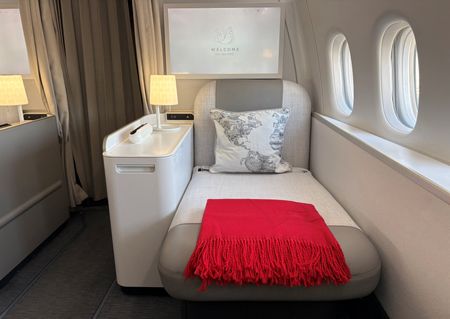
On board, they can spend their flight in a private suite, wearing designer pyjamas and eating food designed by Michelin-star chefs.
"We really wanted to move upmarket," Air France's Executive Vice President Customer Fabien Pelous told Reuters on board the plane.
"Over the past five years, we have created this new cabin and we have paid attention to every detail to push it to the maximum of the expectations of our customers," Pelous said. "We wanted to create the space like in a private jet."
Apart from the €1 billion investment in lounges, cabins and improved WiFi over a five-year period, he said Air France was spending another €1 billion a year as part on its annual fleet renewal costs.
SOCIETY'S WIDENING DIVIDE
The widening gap between the experience of elite airline passengers and those flying economy reflects society as a whole.
The surge in fuel costs, linked to the US-Israeli war with Iran, and an attendant rise in inflation has helped to spark social unrest over the cost of living in some countries, including France. It coincides with an artificial intelligence-led surge in stock markets and the creation of a new super-rich class.
Aviation analyst John Strickland said airlines were willing to reduce the overall number of seats in order to increase their premium sector, which he said had grown substantially.
"It's understandable why airlines are investing in that, changing their cabin configurations with lower overall seats," he said.
Industry body the International Air Transport Association in a report in June found that overall growth in travel was slowing, with passenger traffic, across all classes, expected to increase by only 2.1% this year, compared with 5.3% last year.
Air France does not break out separate figures for its highest class, but said the combined first and business-class sector grew by 28.1% in 2025 and 26.9% in 2024, while economy revenue stagnated.
Its first-class flights start at just below $14,000 for a Paris-New York return ticket, which the company says offers a unique experience.
"We did invest a lot of money both on the ground and in the air," Chief Executive Ben Smith told Reuters in an interview. "This particular cabin or class is unmatched."
The Skytrax World Airline Awards, one of the best-known airline rankings, this year named Air France the world's best first-class airline.
THE ADVANTAGE OF ANONYMITY
The amount of space and resources allocated to each first-class passenger means they have a heavy carbon footprint, although lighter than if they travelled in a private jet.
Air France says its services can also be preferable for showbiz stars and other VIP travellers because they provide anonymity whereas private jets, which owners have to register, can be tracked on aviation surveillance websites.
Other airlines are also seeking to increase their luxury appeal.
In Asia, Air India has rolled out new cabins on some international routes, while IAG-owned British Airways earlier this month said it was revamping its A380 fleet to reduce the overall number of seats and increase the focus on premium customers.
Roberto Alvo, the chief executive of LATAM Airlines Group, said this month he believed airlines with robust premium offerings would emerge the strongest from the current economic turmoil, which he predicted would lead to some consolidation.
In the US, traditionally low-fare airlines such as Southwest, Frontier, JetBlue and Allegiant are moving upmarket.
Delta Air Lines has also said it is targeting the upper end of what is known as a "K-shaped economy", in which sections of the population are becoming richer and others — the downward arm of the K — are becoming poorer.
Air France's Pelous acknowledged that even some of the rich could start to worry more about cost as the war in Iran, which began at the end of February, continues to drive energy prices, but he said the company would not change its luxury strategy.
The price of jet fuel, which accounts for 30% to 40% of airlines' expenses, has more than doubled since the start of the year.
"The first impact of this war is a huge increase in the cost of petrol that definitely affects us," Pelous said. "But despite this complicated context, we want to maintain our strategy to move upmarket."
($1 = 0.8905 euros)
(Additional reporting by Abhijith Ganapavaram and Allison Lampert; Editing by Adam Jourdan and Barbara Lewis)
Find it fast
Looking for more insights? Explore our other news sections for updates on sustainable finance, companies and financial education