Germany wants seat on ECB's executive board, finance minister says
By Maria Martinez and Jan Strupczewski
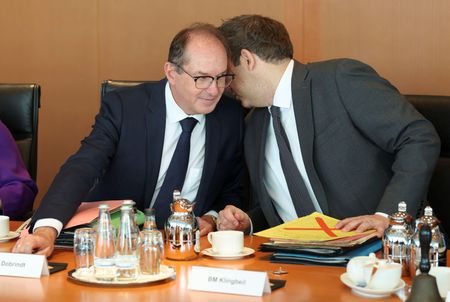
BERLIN, Oct 9 (Reuters) - Germany will nominate a candidate to fill a vacancy on the European Central Bank's executive board, Finance Minister Lars Klingbeil said on Friday, a move seen as a clear sign Berlin will not contest ECB President Christine Lagarde's seat when it becomes vacant next year.
"I am coordinating closely with the federal chancellery on all issues concerning the ECB, and of course, we will put forward a German candidate," Klingbeil said.
Euro zone finance ministers on Thursday started a process to replace ECB board member Isabel Schnabel, who will leave the central bank on January 3 to take up a post at the International Monetary Fund.
European sources told Reuters that Klingbeil told his counterparts on Thursday that the country would propose a candidate to replace Schnabel, who is German.
"In the bilateral discussions here, I have noticed that every colleague is very clear that Germany plays a role at the ECB," Klingbeil added.
The ECB will turn over at least half of its executive board in the coming year as chief economist Philip Lane, who is Irish, is set to leave by May 31 and Lagarde, subject to persistent resignation rumours, is set to leave by the end of October 2027, at the latest.
While Germany has never held the ECB Presidency, getting the job was always seen as difficult since the European Commission and the ECB's banking supervision arm are both headed by Germans.
This likely means that the presidency will be decided between Spain's Pablo Hernandez de Cos, the general manager of the Bank for International Settlements, and Klaas Knot, the former chief of the Dutch central bank.
The German decision to seek Schnabel's seat also means that France will be in prime position to field a candidate for the chief economist job, when it becomes vacant next year.
While technically any country could nominate board members, the euro zone's top three members, France, Germany and Italy, have de facto permanent representation on the board.
Spain is also trying to claim one such permanent spot, leaving the 17 other euro zone members fighting over the remaining two spots.
(Additional reporting by Reinhard Becker and Balazs Koranyi, editing by Linda Pasquini and Alex Richardson)
Find it fast
Looking for more insights? Explore our other news sections for updates on sustainable finance, companies and financial education