Global stocks weather third-quarter AI, bond and crude maelstrom
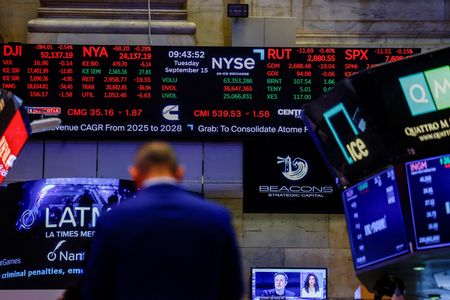
By Marc Jones
LONDON, Sept 30 (Reuters) - Stock market investors might have been expected to run for the hills in the face of an extraordinary surge in global borrowing costs, currency interventions, wars, oil back above $100 a barrel and warnings that AI might wipe out humanity.
Yet the most widely tracked world equity indexes are just 2% off their all-time highs and up more than 12% for the year after another $3 trillion tick higher during a tumultuous third quarter.
Instead it has been G10 government bonds, ultra-safe assets supposed to provide the ballast in global investment portfolios, which have been causing all the worries, especially this month.
In the $29-trillion US Treasury market, which anchors pricing for virtually all financial assets, the key 10-year yield has soared past 5% to its highest level since just before the 2007 financial crash.
Yields in Japan have climbed to multi-decade highs too, while those in Germany, France and Britain have all hit 17 to 19 year peaks. As bond prices move inversely to yield it has meant the biggest hit to investors returns in years.
AXA's chief economist Gilles Moec said that unlike when Treasury yields spiked above 5% in the 1990s and before the financial crisis, this rise was part of a new clearly upward trend.
"What people are worried about is that we are in a completely different structural trend now, that is the long and the short of it," said Moec.
"It is making people very, very nervous," he added.
FINGERS CROSSED
There have been some snags for stock market bulls.
South Korea's KOPSI index, whose chipmakers have been a big driver of AI euphoria, has pulled back almost 20%. It makes it its worst quarter since the COVID-19 pandemic, although it is still twice a valuable as it was this time last year.
Pictet Asset Management's Arun Sai said world stocks were riding a "truly unprecedented" earnings rise. S&P 500 earnings for example are expected to jump at least 30% this year.
"It dwarfs the commodity super cycle, it dwarfs the dotcom boom, everything," said Sai, adding: "We have never seen anything like this outside of a recession recovery".
The moment of the quarter for currency markets, meanwhile, was late July's rare coordinated intervention by Japan and the US to prevent the yen's slide to near 40-year lows from destabilising financial markets.
While the dollar has fallen 3% versus the Japanese currency this quarter, the recent surge in Treasury yields has driven it back up against other top currencies, particularly the Swiss franc, euro and the Mexican peso.
Bitcoin has soared too, while oil's 40% quarterly rise leaves it up 70% for the year. It is also Brent's second-biggest quarterly jump since Q2 2020 after the tumble it took when COVID-19 first shuttered the global economy.
Although Turkish markets were rattled this month by what one top official described as a Ponzi-like funds scheme, large, developing economies, like tech stocks, seem to be largely surviving the bond market selloff.
"We haven't had the big risk off that we are all afraid of," said Viktor Szabo, an EM portfolio manager at Aberdeen. "So we are still sitting here fingers crossed, but it will be interesting to see what happens with the dollar from here."
FINAL LAP There is plenty in store for the rest of the year, with the conflicts in the Middle East and Ukraine both grinding on.
Interest rates are expected to keep rising and the first weekend throws up the first round of the presidential election in Brazil, South America's biggest economy.
US midterm elections in early November will be even bigger, with polls showing US President Donald Trump's Republican party could lose the House of Representatives and maybe even the Senate.
That could make for a very interesting end to 2026, although what investors want to know most is how high bond yields might go and whether the AI-driven equity rally cracks.
"Whether or not this breaks markets?" Kathryn Exum Co-Head of Sovereign Research & Strategy at Gramercy said, referring to level of borrowing costs.
"I think you'd have to see these (10-year Treasury) yield levels sustained at a little bit higher rate than where we're at currently."
(Reporting by Marc Jones; Additional reporting by Canan Sevgili; Editing by Alexander Smith)
Find it fast
Looking for more insights? Explore our other news sections for updates on sustainable finance, companies and financial education