Dollar dips after four-day streak of gains, yen holds near 40-year low

By Chuck Mikolajczak
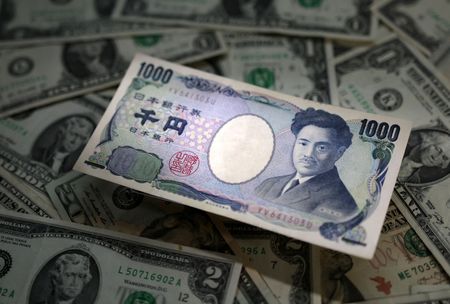
NEW YORK, July 22 (Reuters) - The dollar dipped from a one-week high on Wednesday after four straight daily advances, while the yen recovered slightly from its weakest level in nearly four decades as traders gauged the likelihood of intervention from Tokyo and the chances of faster rate hikes by the Bank of Japan.
The dollar has been rising in recent days as increased tensions in the U.S.-Iran war have caused a reversal in oil prices and again fanned inflation fears.
Oil prices touched their highest in almost six weeks, with U.S. crude last up 3.28% to $87.11 a barrel and Brent at $94.34 per barrel, up 3.66%, as concerns about supply disruptions increased.
Four more tankers changed course in the Red Sea on Wednesday after Iran-aligned Houthis in Yemen threatened the southern route out, while U.S. Secretary of State Marco Rubio said Iran was not serious about peace talks.
"There are negotiations going on in the background, so ultimately, markets are trying to look at it from a different, not necessarily more positive perspective," said Juan Perez, director of trading at Monex USA in Washington.
"Because of the general idea that the scope is so large and this has escalated too much, that there's going to be an immediate attempt to try to urgently end this. So that's kind of the narrative and that's helping markets, that's not a very dollar positive thing."
The dollar index, which measures the greenback against a basket of currencies, fell 0.08% to 101.10, with the euro up 0.12% at $1.1411.
Crude prices had been coming down since May on optimism a durable peace deal could be reached and, along with cool U.S. inflation readings, dented market expectations for rate hikes from the Federal Reserve.
Expectations for a hike from the Fed at its July meeting have been edging back up along with oil prices, with markets now pricing in a 26.2% chance for an increase, according to CME FedWatch, up from 10.7% a week ago.
YEN HOVERS NEAR FOUR-DECADE LOW
The Japanese yen strengthened 0.07% against the greenback to 163.04 per dollar.
The currency weakened to 163.23 on Tuesday, its lowest since December 1986 as investors adjust to a changing policy backdrop under Japanese Prime Minister Sanae Takaichi, whose administration has struggled to shake off views that it may pressure the Bank of Japan (BOJ) to delay further rate hikes. Markets are currently pricing in about 27 basis points of hikes from the central bank this year, according to LSEG data.
Reuters reported that the BOJ remains on alert to upside inflation risks that could lead to faster interest rate hikes than markets project, according to three sources familiar with its thinking.
Japan's Finance Minister Satsuki Katayama has said authorities would take decisive action if needed to curb excessive currency weakness. Tokyo had intervened in April and May, when the yen weakened beyond the 160-per-dollar level.
Those efforts, however, have done little to stem the tide of the yen's broader trajectory, which analysts say is being driven in part by broad-based dollar strength and the BOJ's still-low interest rates.
Mallika Sachdeva, head of FX thematics at Deutsche Bank Research, said in a note that Japan's policy makers have focused on stabilizing the currency over the past few months, but "if fiscal capacity is becoming the most important policy criteria, incentives could shift from FX to yield management," and the ultimate impact on the dollar/yen "will depend on the levers the government chooses to pull to manage yields."
Sachdeva said that if the Government Pension Investment Fund (GPIF) is mandated to bring money back into domestic assets that could be very bullish for the yen, but if the BOJ "is coopted to support bonds through renewed JGB purchases, this could be very negative."
Sterling strengthened 0.05% to $1.3375, putting it on track to snap a four-session streak of declines. British inflation cooled by more than expected last month as a brief de-escalation in the Iran war lowered fuel prices, but the slowdown is likely to offer only temporary relief to new Prime Minister Andy Burnham as he seeks to ease living costs.
Burnham said he was making no unfunded promise to change the tax-free personal allowance and that decisions on taxation would be taken at the next fiscal update expected in several months.
(Reporting by Chuck Mikolajczak; additional reporting by Niket Nishant in Bengaluru and Tom Westbrook in Singapore; Editing by Sriraj Kalluvila, Kirsten Donovan)
Find it fast
Looking for more insights? Explore our other news sections for updates on sustainable finance, companies and financial education