Europe's heatwave curbs French nuclear plants
By Forrest Crellin and Hugo Lhomedet
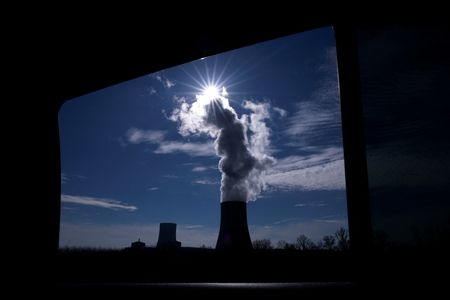
June 24 (Reuters) - A heatwave sweeping western Europe reduced France's nuclear output on Wednesday as high temperatures across the country reduced access to water needed to cool reactors.
Output was reduced by 4.1 gigawatts, or 7%, of total power demand at midday, data from French utility EDF showed.
Temperatures have topped 40 degrees Celsius (104 degrees Fahrenheit) in some places in France, which, combined with reduced wind speeds, has boosted wholesale electricity prices.
Wholesale spot power prices in France and Germany on Tuesday reached their highest level since mid-January 2025 as electricity systems grappled with the heat and relied on gas generation.
France is also usually a large net exporter of cheap electricity to neighbouring countries, but as the temperatures have risen exports have dropped, data from grid operator RTE showed.
Exports from France dropped to around 3 GW during the afternoon on Wednesday compared to 10 GW to 12 GW recorded last week at the same time, reducing the cheap supply for neighbours and cutting into profits from transmission.
"Climate change is demonstrating how extreme heat can be as disruptive as the (price spikes from cold weather and low renewables) witnessed during winter," Kpler analyst Alessandro Armenia said.
"We are surprised now, but we should expect next summer to exhibit similar dynamics, as climate change is undeniable," he said.
The heat has reduced output at the Saint-Alban 2 and Bugey 3 reactors on the Rhone river in eastern France, and the Nogent 2 reactor on the Seine southeast of Paris.
The Golfech 2 reactor on the Garonne river in southwest France went offline late Monday due to the heat.
French environmental regulations force nuclear operator EDF to reduce output when river temperatures reach a certain threshold to protect local ecosystems.
It was not certain how long the current heatwave, driven by a weather pattern known as an Omega block due to its shape, which allows temperatures to build day after day, would last.
Europe is warming at more than twice the global average, the World Meteorological Organisation has said, which makes prolonged heat episodes increasingly likely.
The European power system is increasingly reliant on renewable power generation, where the evening drop in solar power is replaced by wind and baseload power from nuclear, coal and gas, driving up prices when the sun goes down.
Nearly all countries have seen an increase in thermal generation, which includes gas and coal, in the evenings, including France where gas-fired generation is usually minimal, Kpler data showed.
This week, the pattern is exacerbated by overall higher cooling demand and below-normal wind generation, requiring the use of more gas-fired power, with the most expensive plants setting the wholesale price, LSEG analyst Nathalie Gerl said.
This week is an outlier, however, as the summer has seen regular oversupply on the electricity market, she added.
(Reporting by Tristan Veyet and Hugo Lhomedet in Gdansk and Forrest Crellin in Paris; editing by Tomasz Janowski and Jason Neely)
Find it fast
Looking for more insights? Explore our other news sections for updates on sustainable finance, companies and financial education