At G7, Macron says he expects progress on broadening access to Anthropic's Mythos
By Gabriel Stargardter
EVIAN-LES-BAINS, France, June 17 (Reuters) - French President Emmanuel Macron said on Wednesday he believed progress would be made in coming weeks on broadening access to leading U.S. AI models, as G7 leaders pledged closer coordination on the risks and opportunities of frontier AI.
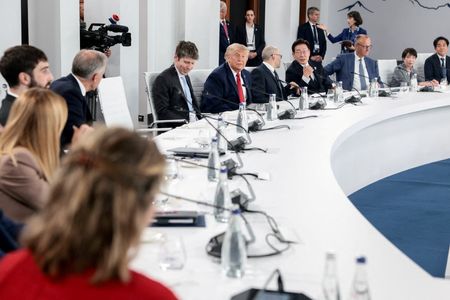
Macron's comments came as G7 leaders, who had gathered for the June 15 to 17 Group of Seven summit in the French resort of Evian-les-Bains, discussed the creation of a "trusted partners" scheme granting access for non-U.S. nations to advanced U.S. AI models from firms like Anthropic.
Cybersecurity experts are concerned Anthropic's Mythos, developed to find coding flaws to bolster cyberdefences, could potentially turbo-charge attacks on the very systems it aims to protect. Last week, U.S. President Donald Trump told Anthropic to block foreign nationals from accessing its advanced models, citing national security concerns.
That move spurred G7 discussions on the creation of the "trusted partners" scheme, which could open a path around the U.S. restrictions. The "trusted partners" could be countries or companies, Reuters reported on Tuesday, and would allow them to use the models to develop stronger cybersecurity defences against rivals like China.
REGULATING AI
Macron said it was in Washington's interest to make Mythos more broadly available, as nobody would buy U.S. AI if there were fears it could be shut off at any moment.
Europe is struggling to balance a push for greater tech sovereignty, while also keeping pace with technological advances largely led by U.S. tech firms that dominate cloud computing, semiconductor design and cutting-edge AI research.
In a joint statement on Wednesday, G7 leaders said they would task finance officials, regulators and cybersecurity experts with assessing how frontier AI models could impact financial stability, productivity and labour markets.
AI executives from Anthropic, OpenAI and Google, which are all developing highly advanced models, attended a working lunch on Wednesday at the G7 to discuss regulation and AI infrastructure.
At the lunch, OpenAI CEO Sam Altman urged the G7 to take control of AI governance. He said the debate over whether AI is useful was over and that far more powerful systems would emerge, potentially reshaping the global economy and scientific discovery. But he added that it was for democratic governments — not AI companies — to decide how it is governed.
"Do not cede your responsibilities to AI labs like mine," he said. "We develop the technology, and the citizens of the free world make the rules."
EUROPE STRIVES TO FIND RIGHT TECH BALANCE
European policymakers have increasingly framed AI as a matter of economic and national security. The European Commission recently unveiled plans for AI "gigafactories" and large-scale computing infrastructure designed to provide the region with sovereign access to computing power.
It has proposed laws to boost domestic cloud, AI and semiconductor industries and cut reliance on U.S. Big Tech, although critics say Europe remains years behind U.S. rivals.
Speaking at the tech leaders' lunch, European Commission President Ursula von der Leyen said it was in the mutual interest of the U.S. and the European Union for the EU to use the best AI models, while praising U.S. moves to ensure AI firms acted responsibly when introducing powerful new models.
"We use each other's trusted technology, and our financial systems are interconnected," she said.
(Additional reporting by Aditya Soni; Editing by Hugh Lawson)
Find it fast
Looking for more insights? Explore our other news sections for updates on sustainable finance, companies and financial education