SpaceX's Starship makes orbital debut deploying Starlinks before early ending
By Joey Roulette and Steve Nesius
STARBASE, Texas, Sept 28 (Reuters) - SpaceX's next-generation Starship rocket reached orbit for the first time despite an unexpected engine shutdown midflight on Monday and deployed the first batch of new Starlink satellites, but the mission was cut short and ended with a controlled and fiery touchdown in the Pacific.
SpaceX's next-generation Starship rocket reached orbit for the first time on Monday despite having one of its engines shut down unexpectedly, overcoming a hitch mid-flight to deploy its first batch of new Starlink satellites in a truncated mission ending hours earlier than originally planned.
The mission was scheduled to last 10 hours, but was reduced to three hours after the engine problem. Launching from Texas, it was the rocket's 14th flight since 2023, as Elon Musk's company plans to put the vehicle into routine use starting later this year.
SpaceX shares, which were up nearly 9% from the IPO price, were down about 1% on Monday. Much of SpaceX's market worth and continued investor confidence in the company — valued at $2 trillion as of Friday's close — ride on the success of Starship, which was designed as the world's first fully reusable spacecraft.
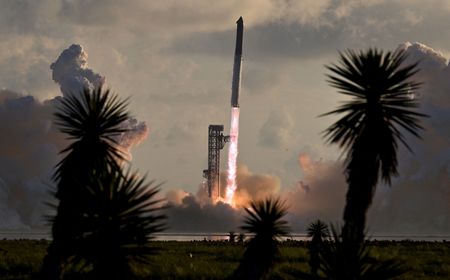
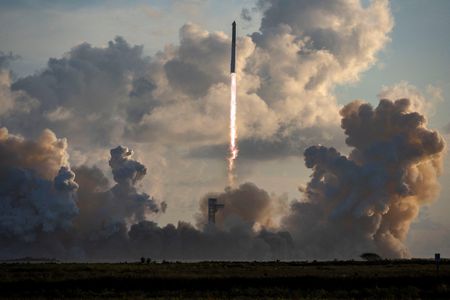
The uncrewed 40-story-tall vehicle, consisting of a Super Heavy booster rocket topped by the main upper-stage Starship vessel, thundered off its launch pad from SpaceX's Starbase complex along the Gulf of Mexico near Brownsville.
The Super Heavy booster lofted the Starship upper stage into space before returning itself to Gulf waters for an engine-controlled splashdown, following hard landings for the booster on two previous missions. Some engines on that booster stopped working during its descent, SpaceX said.
Upon reaching space, one of Starship's three main engines shut down prematurely, a development that led SpaceX spokesperson Dan Huot to announce on the company's live stream of the mission that the craft would be unable to reach orbit.
"The team has made the call not to commit to orbit," Huot said.
But Huot reversed course minutes later after an update from engineers confirmed that the craft could still attempt an engine firing that would boost it into orbit, which Starship successfully did minutes later.
Starship's controlled descent into the Pacific culminated with a thruster maneuver that flipped the vehicle vertically so that it hit the sea in a nose-up position. Fire engulfed the base of the rocket as it touched down on the ocean surface before tipping on its side, followed by a large fireball. The company had not planned to recover the spacecraft from the sea following the mission.
Once in orbit, Starship deployed 26 next-generation Starlink satellites one by one at an altitude of roughly 269 km (161 miles).
"All 26 Starlink V3 operational satellites deployed and operating nominally," Musk wrote on X.
Starship was built to launch SpaceX's Starlink satellites more frequently and carry future NASA missions to the moon. Reaching orbit, a primary benchmark for any new rocket designed to deliver payloads to space, was a long-delayed feat for Starship, which Musk once predicted would be achieved in 2022, to be followed by satellite deployments in 2023.
All 13 of Starship's previous test flights since 2023 were limited to suborbital space, despite a nearly decade-long development campaign that has cost SpaceX more than $15 billion to date. Musk has said he envisions ultimately flying hundreds or thousands of Starship missions a year, a launch pace unprecedented in the space industry.
"Starship is 2 to 3 years away from hourly flights," Musk wrote on X on Sunday.
TEST MISSION WITH REAL PAYLOAD
Monday's voyage counted as a test flight even though Starship carried its first orbital payload.
Analysts estimate Monday's launch of SpaceX's new V3 Starlink satellites equals hundreds of millions of dollars in projected revenue for its Starlink unit, based on the network's added customer capacity — underscoring Starship's role in serving the company's profit nucleus.
According to SpaceX, the V3 Starlink satellites deployed on Monday can handle 10 times more data than their predecessor V2 mini-sats that the company has launched 20 or 30 at a time on its workhorse Falcon 9 rockets. Seeking to build out his broadband satellite constellation at a faster pace, Musk wants to launch the V3s in batches of 60 per launch once Starship goes into routine operation.
Starship's orbital debut came three months after SpaceX went public with a record-shattering IPO in June that made it the sixth-biggest US company by value and turned Musk, who founded it in 2002, into the world's first trillionaire.
Starship is also set to play a pivotal role in NASA's Artemis program, which aims to return astronauts to the moon's surface for the first time since 1972 and build a long-term lunar presence as a stepping stone to eventual human exploration of Mars.
(Reporting by Joey Roulette; Editing by Christian Plumb and Will Dunham)
Find it fast
Looking for more insights? Explore our other news sections for updates on sustainable finance, companies and financial education