Stocks rally, dollar dips after Democrats' midterm sweep
By Amanda Cooper
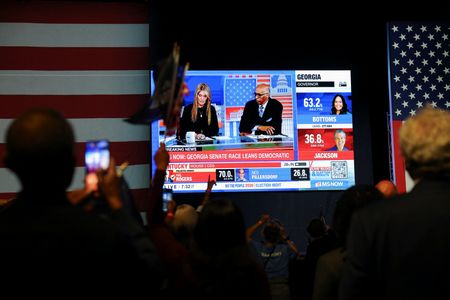
LONDON, Nov 4 (Reuters) - Global stocks and the dollar recovered on Wednesday from lows hit overnight after Democrats won control of both the Senate and the House in the US midterm elections, which has fuelled fears that rapid AI sector growth could be hamstrung by regulatory scrutiny.
In a major setback to President Donald Trump, Democrats scored sweeping victories in Republican strongholds for the first time in generations.
The breadth of the party's success was underscored by gains in districts long considered safely conservative, highlighting a political shift that may have caught some investors off guard.
"Democrats pulled off a double victory in the US midterm elections that few saw coming at the onset of the year. The blue wave means the federal government is sure to be divided on most issues," Deborah Cunningham, chief investment officer, global liquidity markets at Federated Hermes, said.
"That typically creates a blockade against new legislation — an environment which broad financial markets traditionally view favourably as variables decrease."
Opinion polls have shown Democratic voters favouring more control over AI, and investors expect the Democratic-controlled Congress to apply more scrutiny to the sector.
AI stocks in Asia initially led the decline in equity markets, while bonds and safe-haven currencies such as the Swiss franc gained.
By the time the bulk of the midterm results had filtered through in the European morning, equities had turned higher. MSCI's All-World index was up 0.13%, while Europe's STOXX 600, which has acted as a hedge against AI-related risks, was up 0.5%. US stock futures also edged into positive territory, having fallen by as much as 2% overnight.
Shares in Elon Musk's Tesla and SpaceX, which he intends to merge, were down around 4.5% to 5% on Europe's Tradegate platform, compared with declines of around 0.3% to 0.9% for other Big Tech stocks.
"Overall, these results have had a mild impact on markets so far. Investors will move on from trading the uncertainty of the election results to trading the reality of what they mean for policy," XTB research director Kathleen Brooks said.
"This is bad news for Tesla and SpaceX on Wednesday, but the semiconductor names, the backbone of the AI trade, could brush off concerns about AI regulation and continue to move higher after Tuesday’s stunning rally for the sector," she said.
The AI boom has helped propel global markets in recent years, driven by heavy spending from tech giants racing to build data centres and expand computing capacity. That has made investors acutely sensitive to anything that could derail the technology's rapid expansion.
The election outcome could also hold broad implications for the US fiscal outlook as well as sectors such as defence, healthcare and banking.
Futures on the small-cap Russell 2000 index, which is more exposed to the US domestic economy, were last up 0.7%, having lost 1% earlier.
INVESTORS FLOCK TO SAFE HAVENS
Treasuries rallied as investors expect gridlock in Washington to cut government spending, with AI regulation also possibly slowing growth and reducing the need for rate hikes.
The yield on the benchmark US 10-year Treasury note was down 3 basis points on the day at 4.92%, having fallen as much as 6 bps to a low of 4.89% overnight, which, in turn, weighed on the dollar.
"Bonds are coming out as the clear winner as markets put the AI trade on the chopping block and embrace the higher possibility that further tax cuts are put on ice and government spending slows," Prashant Newnaha, senior rates strategist at TD Securities in Singapore, said.
In currencies, the dollar weakened broadly, leaving the euro up 0.4% at $1.133 and the pound up 0.5% at $1.348.
The yen and the Swiss franc — both safe-haven currencies — also notched up gains. The Swiss franc was the standout performer, with the dollar down 0.6% against it at 0.8163 francs. The dollar also fell 0.4% against the Japanese yen to 158.12.
In the oil market, prices were choppy on Wednesday after they hit a four-week low in the previous session as investors weighed talks to end the wars in Ukraine and Iran against worries that recent attacks in both conflicts could further disrupt supplies. Brent crude was down 0.4% on the day at $103.17 a barrel.
(Additional reporting by Ankur Banerjee and Rae Wee in Singapore; Editing by Shri Navaratnam, Christopher Cushing and Tomasz Janowski)
Find it fast
Looking for more insights? Explore our other news sections for updates on sustainable finance, companies and financial education