Rouble's strength squeezes Russian exporters despite Iran war oil gains
By Gleb Bryanski and Elena Fabrichnaya
ST. PETERSBURG, Russia, June 3 - A strong rouble is squeezing Russian commodity exporters, offsetting any gains from higher oil prices, and needs to fall to around 90 per U.S. dollar, top Sberbank executive Alexander Vedyakhin told Reuters.
Sberbank raised its forecast for commodity exports this year by 27% to $491 billion after war in the Middle East led to the effective closure of the Strait of Hormuz, driving international oil prices to peaks well above $120 per barrel in April.
Sberbank projects the average price for Russia's Urals blend of oil in 2026 to be $10 to $15 higher than the $59 per barrel set out in the government's conservative forecast.
The unprecedented disruption has also driven up prices for other commodities, including grains and fertiliser, which can benefit Russia.
Vedyakhin, however, said the strong rouble was a problem as exporters have to cover rising domestic costs.
"We also need to talk about the strong rouble, which puts significant pressure on exporters. This affects exporters and, consequently, the budget, so the gains in dollars that companies receive from rising oil prices are largely offset by the strengthening of the rouble," he said ahead of Russia's biggest economic conference in St. Petersburg.
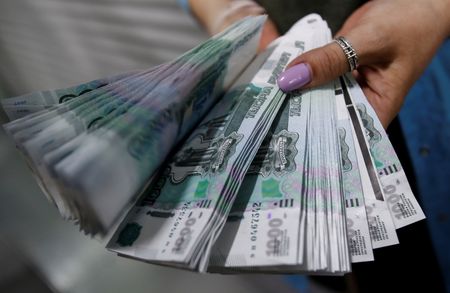
The rouble has strengthened by around 12% to around 71 against the dollar in the last two months on an inflow of foreign currency from Russian exports. The Russian currency has rallied by over 55% against the dollar since the start of 2025.
SLUGGISH ECONOMY AND RISING 'REAL INTEREST RATE'
The Russian economy slowed to around 1% growth last year and is expected to grow by only 0.4% in 2026, according to the government's forecast. Sberbank's growth forecast for 2026 is more optimistic at between 0.5% and 1%.
President Vladimir Putin has urged oil firms to use increased earnings from exports based on high prices to pay off any debts, but Vedyakhin said companies were instead seeking loan restructuring.
The central bank's key interest rate, now at 14.5%, had fallen at a slower pace than inflation, meaning the real interest rate is increasing, Vedyakhin said.
As examples of the companies challenged by debt, he cited the metals and forestry sectors and said the coal industry faced the "utmost difficulty".
"At the current key rate, we are not seeing any growth in lending for investment and won't see it in the near future," he said, estimating the overall growth in credit at between 10% and 12% in 2026, driven mainly by short-term borrowing for operational needs.
Since inflation has eased in recent weeks, he said the central bank could cut by more than its usual 50 basis points at the upcoming meeting on June 19.
He was doubtful about government expectations consumer demand could boost overall growth, saying that neither the population nor the government had the money.
"We are seeing the state of the budget. It is no secret that a consolidation is expected. In my view, we will not see a consumer boom before the end of 2026 at current external conditions," he said.
(Writing by Gleb BryanskiEditing by Andrew Osborn and Barbara Lewis)
Find it fast
Looking for more insights? Explore our other news sections for updates on sustainable finance, companies and financial education