Oil prices set for fourth straight monthly gains as tanker attack highlights supply risks
By Arathy Somasekhar
HOUSTON, Oct 30 (Reuters) - Oil prices rose on Friday to their highest levels since the end of April, putting them on track for a fourth straight month of gains, as traders braced for a potential escalation in the Iran war after the US midterm elections, with an attack on a tanker in the Strait of Hormuz highlighting supply risks.
Brent crude futures for December, which expire on Friday, were up $2.287, or 2.5%, at $117.75 a barrel as of 1:07 p.m. EDT (1707 GMT), after touching a high of $118. The more active January contract gained $3.23 to $114.03.
US West Texas Intermediate (WTI) crude futures climbed $2.74, or 2.7%, to $104.79.
For the month, Brent was on course to finish 13% higher, while WTI was heading for a 15% jump.
"Traders will remain focused on oil flows out of the Middle East and the likely escalation by US and allied forces," said Dennis Kissler, senior vice president of trading at BOK Financial.
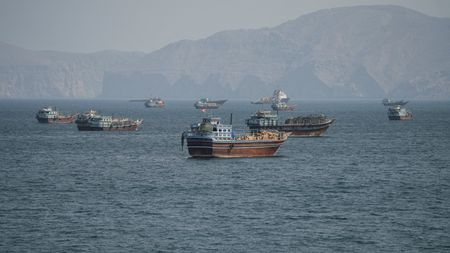
On Friday, a tanker in the Strait of Hormuz — the key sea outlet for Gulf crude and fuel supplies — was hit by explosive devices attached by a small boat, said the UKMTO, the British maritime security service. It was not immediately clear who was behind the attack.
It was the first known successful strike using limpet mines, explosives that are attached to a ship's hull from a small boat, in the waterway since the US-Israeli war with Iran began in February, maritime sources said.
"Continued kinetic action around the Strait of Hormuz amidst doubts of a viable diplomatic pathway is keeping oil prices elevated in expectation of an escalation of the conflict in coming weeks," said Saul Kavonic, head of energy research at MST Marquee.
Meanwhile, Libya's National Oil Corporation said an armed group shut a valve on Friday on the main Hamada crude oil pipeline, which links the Hamada field to the Zawiya refinery. It said the closure of the valve had halted the flow of about 15,000 barrels per day.
'HIGHER LIKELIHOOD OF AN ESCALATION'
Qatari mediators returned to Tehran on Friday as part of coordinated efforts to reach a deal between the US and Iran, an official briefed on the talks told Reuters.
Still, Yemen's Iranian-backed Houthi militants said on Thursday they had attacked several sites in Saudi Arabia, including the large Ras Tanura oil refinery, the Rabigh refinery and a production facility in Abqaiq owned by state oil company Saudi Aramco.
A Saudi-led coalition also said it had intercepted a cruise missile launched by the Houthis towards the kingdom's western region. Saudi Arabia's crude exports have risen in October compared with September, two of three ship-tracking companies said, despite Iranian attacks on shipping in the Gulf and claims by Yemen's Iran-aligned Houthis of attacks on Saudi oil facilities.
US President Donald Trump said on Thursday that Vice President JD Vance had reached out to Iran to help the country get medical supplies, after US media reported Vance had written to Tehran's top security official to revive peace talks.
Iran has received a letter from Vance, but it has not responded to it yet, Iran's semi-official Tasnim news agency reported, adding that Tehran wants the US to meet its conditions and "any position that contradicts this framework is unacceptable."
Oil prices could become even more volatile in the next couple of weeks due to Israel's recent elections and the US midterm elections on November 3, according to a Saxo Bank briefing in Singapore on Thursday.
The Danish bank said heightened uncertainty makes it difficult to forecast prices, but added that crude is expected to trade in a higher range of $70 to $90 a barrel even after the conflict ends, compared with a pre-war range of $60 to $70.
The US oil rig count, an indicator of future output, rose by two. US crude oil output increased in August, while demand for crude oil and petroleum products declined, the US Energy Information Administration (EIA) said in its Petroleum Supply Monthly report on Friday.
(Reporting by Anna Hirtenstein in London; Additional reporting by Helen Clark and Siyi Liu; Editing by Christian Schmollinger, Jan Harvey and Paul Simao)
Find it fast
Looking for more insights? Explore our other news sections for updates on sustainable finance, companies and financial education