Oil edges up as Hormuz tanker incidents highlight shipping risks
By Helen Clark and Trixie Yap
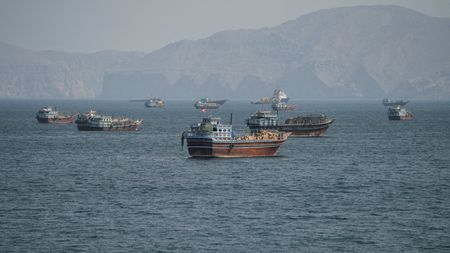
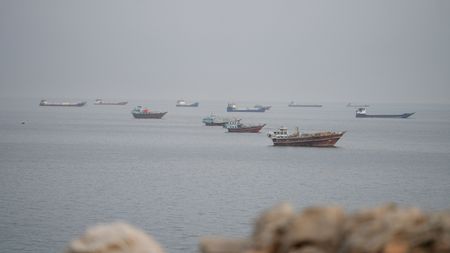
Nov 16 (Reuters) - Oil prices inched back up on Monday, after fresh tanker incidents in the Strait of Hormuz underscored risks to Middle East supplies, although shipments through the strategic waterway have largely recovered to pre-war levels.
Brent futures were up 5 cents, or 0.1%, to $95.89 a barrel by 0757 GMT. US West Texas Intermediate (WTI) crude gained 9 cents, or 0.1%, to $88.65. Both benchmarks had fallen in early Asian trade, with Brent down as much as 1%.
Oil closed lower on Friday as the market weighed signs of lower geopolitical risk from the US-Israeli war against Iran, now in its ninth month. The benchmarks fell 16% and 13%, respectively, the prior week.
Two oil tankers struck mines in the Strait of Hormuz that led to explosions, Iran's Revolutionary Guards said on Monday, after six tankers caught fire in similar incidents on Sunday and Monday. Reuters could not independently verify the report.
The recovery of export flows from OPEC+ remains fragile, with "regional supply highly vulnerable to renewed disruption", said BMI analysts in a client note.
"As such, physical constraints on production and exports, alongside fluctuations in the geopolitical risk premium, will continue to dominate price action until a settlement is reached between Washington and Tehran."
High shipping rates are also putting a floor on oil prices, said Tim Waterer, chief analyst at KCM Trade.
Rates remain high because of the risks tankers face carrying crude through the Strait of Hormuz and because the number of ships tied up shuttling oil through the waterway for transfer to other vessels has reduced the available fleet.
Limiting price gains, the world oil market will return to a surplus in the fourth quarter of this year, the International Energy Agency said on Friday, as Middle East exports recover faster than global oil demand despite continued attacks on shipping.
"For the first time since the US-Iran conflict began, traders are actively contemplating the possibility of excess supply rather than persistent tightness. That shift in narrative is clearly dampening the tone," said KCM Trade's Waterer.
Oil supply will average 105 million barrels per day in the fourth quarter, 1.7 million bpd higher than forecast demand, the IEA said. The IEA had previously forecast a fourth-quarter supply deficit.
The agency also gave more details of remaining volumes from a record release of oil from its members' emergency reserves pledged in March, saying 71 million barrels would be made available by the end of February, including 15 million barrels of diesel to ease market tightness.
About 15 million barrels per day of crude oil moved through the Strait of Hormuz in 2025, according to IEA data.
Signs of lower demand in China, the world's second-largest oil consumer, also pressured prices. The latest data from the country's National Bureau of Statistics on Monday showed refinery throughput for October fell 2% from a month earlier and was down 8.1% from a year ago.
The drop in throughput, along with an increase in domestic output and overseas imports, indicated a build in Chinese crude inventories of 492,000 barrels per day last month, according to Reuters calculations based on government data.
(Reporting by Helen Clark and Trixie Yap; Editing by Christian Schmollinger and Jacqueline Wong)
Find it fast
Looking for more insights? Explore our other news sections for updates on sustainable finance, companies and financial education