Nvidia CEO Jensen Huang resigns in blow to AI boom he helped foster
By Aditya Soni and Anhata Rooprai
Nov 12 (Reuters) - Nvidia CEO Jensen Huang stepped down on Thursday after revelations of two extramarital affairs, including one involving a suspected Chinese spy, plunged the chipmaker into crisis and sent shockwaves across an AI industry he helped bankroll.
Huang's exit caps a tumultuous week for Nvidia, one of the major engines behind the AI boom, and could have far-reaching consequences for US chip export policy and the broader AI ecosystem, given the ex-CEO's push to preserve access to the Chinese market, as well as his close ties with US President Donald Trump.
The crisis has threatened to implicate some Trump administration members, including Commerce Secretary Howard Lutnick, who is facing growing questions over the administration's oversight of chip sales to China, particularly as both he and Huang pushed for relaxing those sales despite scrutiny from longtime China hawks in both parties. The Commerce Department did not immediately comment.
Senior White House officials are discussing whether Lutnick should be pushed out, two people familiar with the situation told Reuters on Thursday.
The White House did not immediately respond to a request for comment on Lutnick's future. Earlier in the day, a White House official said US President Donald Trump "maintains complete confidence in the secretary and his ability to carry out the position."
Huang's departure threatens to disrupt an AI ecosystem that he helped shape by pouring Nvidia's swelling cash pile back into cloud providers, suppliers and the industry's biggest labs. The surge in AI computing demand drove a sevenfold increase in Nvidia's shares through early October, pushing its market value at one point to nearly $6 trillion.
Chief Financial Officer Colette Kress will take over as interim CEO as Nvidia looks for a permanent successor, considering both internal and external candidates, the company said on Thursday.
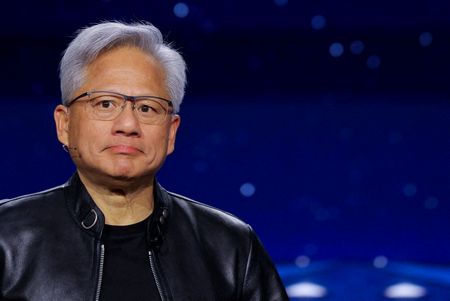
The departure has also ignited speculation over who will ultimately lead the company, long associated with the leather-jacket-wearing Huang, who co-founded Nvidia more than three decades ago.
Kress and longtime Nvidia engineer Ian Buck had emerged as the leading internal candidates among investors and analysts even before Huang's departure.
Nvidia shares were down about 4.8%, paring earlier losses. Shares of rivals AMD and Broadcom rose about 6% each.
Huang, Nvidia's fourth-largest shareholder with a 3.61% stake, will also leave the board. Nvidia named former Synopsys CEO and longtime director Harvey Jones as its first board chair.
"The Board, Estaff (executive staff) and I recognize that this has been an extraordinarily difficult period," Kress wrote in a memo to employees, adding that the company will host a meeting on November 18.
Kress was gathering Nvidia's executive team at its headquarters on Thursday, CNBC reported, adding that Huang had agreed to testify before Congress before Thanksgiving.
Huang has hired law firm Paul Weiss, the New York Times reported, citing two people familiar with the matter. It was not clear what the firm had been retained to do, the report said.
The company has not commented beyond its statement announcing Huang's resignation.
REPLACING HUANG
Pressure had been mounting on Huang in recent days after reports said the 63-year-old, who is married, had an affair with a Chinese businesswoman whom US authorities suspect of spying for Beijing.
The New York Times also reported Wednesday that Huang had an extramarital affair with a senior company executive who reported to him.
While Kress offers investors a familiar hand after 13 years as CFO, analysts have pointed to Buck as a potential longer-term candidate because of Nvidia's reliance on technical leadership. The veteran engineer helped develop its crucial CUDA software platform and now leads its hyperscale AI products.
"The risk is not that Nvidia suddenly loses its technology roadmap ... that roadmap is largely visible for the next several years. The risk is execution. Jensen has been the chief conductor of an extraordinarily complex system," said Michael Feldman, portfolio manager at ClearBridge Investments.
"In a world with real bottlenecks, that coordination is a competitive advantage in itself."
Investor sentiment toward AI stocks has already been shaky as soaring cash burn and rising debt at traditionally cash-rich tech giants fuel doubts over whether the AI boom will pay off.
TRUMP WEIGHS IN
Trump said on Sunday that Huang had "done an amazing job for our country" and that the Nvidia chief had told him he had no idea the Chinese woman he had an affair with was a spy.
On Thursday, the US president suggested former Apple CEO Tim Cook should take over as Nvidia's CEO.
US House Speaker Mike Johnson said it was "critically important for right successor to be chosen to replace Huang," noting there was a growing consensus in Congress on limiting exports of semiconductor chips to China.
HUANG'S ROCK-STAR STATUS
For years, Nvidia was best known to gamers chasing top-tier graphics. But its chips' ability to perform many calculations at once has made them the oil of the AI boom and a strategic prize in the US-China race to dominate the technology. It also made Nvidia the world's most valuable company.
That turned Huang into a rock-star CEO, mobbed by fans in Taiwan and South Korea who ask him to sign books, posters and sometimes even their bodies.
The scandal preceding Huang's departure unfolded over more than a year, beginning with an October 2025 New York Times report linking him to Alice Huang, a former executive at Singapore-based Megaspeed, a coveted official Nvidia cloud partner with priority access to its chips.
Subsequent reports said US intelligence officials believed Alice Huang was acting on behalf of Chinese intelligence. Beijing has denied Alice Huang is a spy.
Washington has also investigated Megaspeed over suspicions it helped China obtain advanced AI chips restricted under US export controls, according to media reports.
Separately, Bloomberg News reported on Thursday that the US Justice Department was investigating Alice Huang over whether entities linked to her were involved in efforts to smuggle Super Micro Computer products to China, citing a person familiar with the matter.
A spokesperson for the Manhattan US Attorney’s office declined to comment on the Bloomberg report. The office previously charged three people associated with Super Micro, including its co-founder, with helping smuggle at least $2.5 billion of US AI technology to China in violation of export laws. Super Micro did not immediately respond to a Reuters request for comment.
Earlier, the Singapore Ministry of Home Affairs said Singapore police had been investigating Super Micro as part of a wider probe into Megaspeed and Alice Huang. The police had reached out to the FBI and the Justice Department for help and had received "limited information or assistance," the ministry said.
Earlier this month, Nvidia's board launched a probe, led by independent directors with outside legal counsel, into whether Jensen Huang had been targeted by a foreign intelligence operation. It also expressed confidence in him at the time.
The controversy escalated on Wednesday when the New York Times reported Huang also had an affair with Kimberly Powell, Nvidia's vice president of healthcare, who reported to him.
(Reporting by Anhata Rooprai and Aditya Soni in Bengaluru, additional reporting by Luc Cohen, Arpan Varghese and Estelle Shirbon; Editing by Sriraj Kalluvila, Arun Koyyur, Saumyadeb Chakrabarty, Anil D'Silva, David Gaffen and Nick Zieminski)
Find it fast
Looking for more insights? Explore our other news sections for updates on sustainable finance, companies and financial education