Exclusive-Russia cuts expected 2026 oil output to 17-year low on war fallout, draft forecasts show
Sept 1 (Reuters) - Russia downgraded oil output forecast for this year to a 17-year low and revised fuel exports outlook for 2026 and 2027 due to the war with Ukraine, according to a government draft forecast seen by Reuters.
The forecasts, which are expected to be finalised at the end of September and are used in drafting the budget, reduced oil production estimates for 2026-2029 by between 16 million and 20 million tons compared to the previous outlook published in May.
Since the war began in February 2022, the European Union has banned most of Russian oil and fuel imports, an important source of revenue for Moscow.
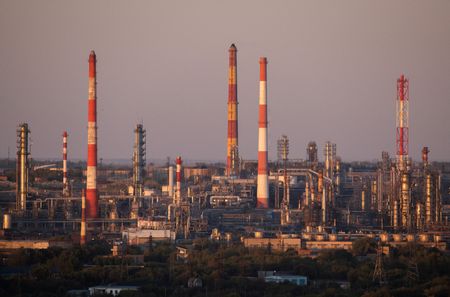
Along with export bottlenecks, intensifying Ukrainian drone attacks on Russia's oil refineries in the past months have also reduced fuel production, triggering gasoline shortages across the country.
In its base case scenario, the government expects that Russia's crude oil production — the world's third-largest — will decline by 17.2 million metric tons this year to 494.2 million tons or 9.88 million barrels per day, its lowest since 2009.
2027-2029 OIL OUTPUT SEEN BELOW 2025 LEVELS
Crude production is expected to recover to 500 million tons next year, but it will still be 16 million tons below the previous forecast. Output in 2028 and 2029 is seen rising further, but still remaining below 2025 levels.
Russia's Deputy Prime Minister Alexander Novak, an oil point man of President Vladimir Putin, acknowledged in June that the country's oil production had fallen since the start of the year, blaming the decline on unplanned maintenance at refineries.
A reduction in fuel output caused by the drone attacks led to an increase of crude oil exports, mainly to China and India.
According to the draft forecast, Russia's crude oil exports could reach 244.7 million tons this year, up from 230.8 million tons in 2025 and 7.5 million tons above the previous outlook.
Crude oil exports are expected to decline to 232.5 million tons in 2027 and then fall sharply to 216.6 million tons in 2028-2029.
To address domestic market shortages, Russia introduced a ban on diesel exports, in addition to restrictions on overseas sales of gasoline and jet fuel.
As a result, the Russian government sees fuel exports falling by 27.3 million tons this year to 98.5 million tons, 24.1 million tons below its previous forecast.
While fuel exports are seen rising to 113.1 million tons next year, they will be almost 13 million tons below the 2025 level and 21 million tons below the previous forecast.
Following are some of Russia's base case scenario forecasts. Previous forecasts, made in May, are in brackets:
2025 2026 2027 2028 2029
actual
Oil and gas 511.4 494.2( 500.0( 505.0( 505.0
condensate 511.0) 516.0) 525.0) (525.0
production, million )
tons
Oil exports, million 230.8 244.7( 232.5( 216.6( 216.6
tons 237.2) 227.4) 236.3) (236.3
)
Oil products exports, 125.8 98.5(1 113.1( 134.0( 130.0
million tons 22.6) 134.0) 134.0) (130.0
)
(Reporting by ReutersEditing by Tomasz Janowski)
Find it fast
Looking for more insights? Explore our other news sections for updates on sustainable finance, companies and financial education