Euro gets much-needed reprieve as AI wobbles rock the dollar
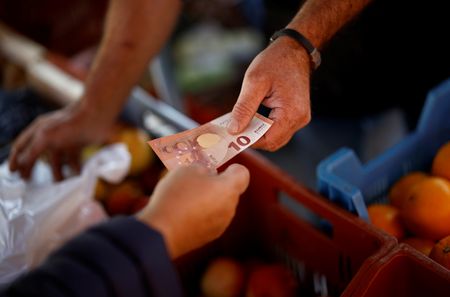
SINGAPORE, Oct 16 (Reuters) - The dollar skidded on Friday toward its first weekly fall in five, lifting the euro from a 17-month low as wobbles in AI investment and a drop in US yields put the brakes on recent gains.
AI stocks have cratered this week and the stress spread to parts of the credit market as investors who have crowded in to bets all along the AI supply chain worry data centre operators might not manage to be profitable in time to pay their debts.
The result has been a flight to Treasuries, where the US 10-year yield is set for its largest weekly fall in more than a year, and to sell a dollar propelled in part by the AI boom boosting the economy.
The greenback traded under pressure through the Asia session, dipping to 157.85 yen for a weekly fall of about 0.3%. It has shed about the same amount on the euro this week and traded at $1.1226 per euro on Friday.
The reversal has come not a moment too soon for the common currency, which over the previous five weeks had dropped more than 3% on the dollar on jitters about France's growing debt pile and a winter energy squeeze.
With the market positioned long in dollars, more AI wobbles could unwind that and push the dollar down further.
"The reaction function of the dollar to a serious repricing of the AI capex boom should be unambiguously dollar bearish," said Spectra Markets president Brent Donnelly.
"If the market is pricing rising odds of peak AI capex, the USD is a sell. The entire US economy is a one-legged stool balanced on the AI trade."
The dollar index which measures the US currency against six major peers, was at 101.89, set for a 0.2% drop for the week.
Sterling was a fraction firmer at $1.3303, for a weekly rise of 0.5%, helped by data showing Britain's economy unexpectedly grew 0.1% in August. The New Zealand dollar climbed 0.5% to $0.5655 for a weekly gain of 0.7%.
The Australian dollar edged up to $0.6946 but was an outlier in heading for a fall of 0.5% on the dollar this week, after a surprisingly soft jobs report on Thursday had markets paring back expectations for another rise in interest rates.
Federal Reserve Chair Kevin Warsh gave few clues on policy at the International Monetary Fund's annual meeting in Bangkok, beyond saying the world has broadly conformed to expectations since the Fed met in September.
Traders are pricing in a 72% chance of the Fed standing pat later this month, up from 53% a month earlier, CME's FedWatch tool showed.
The expected likelihood of a hike rose sharply after a hotter-than-expected CPI report this week, but reversed after Fed officials said the central bank could wait for more clarity before the meeting.
"The thinking goes that if the AI financing correction spreads, that could be a short-circuit of the AI boom, which could affect US growth," said OCBC strategist Sim Moh Siong.
(Reporting by Ankur Banerjee and Tom Westbrook in Singapore; Editing by Edwina Gibbs and Clarence Fernandez)
Find it fast
Looking for more insights? Explore our other news sections for updates on sustainable finance, companies and financial education