Dollar at one-month low as cooling inflation offsets oil price risks
By Stefano Rebaudo
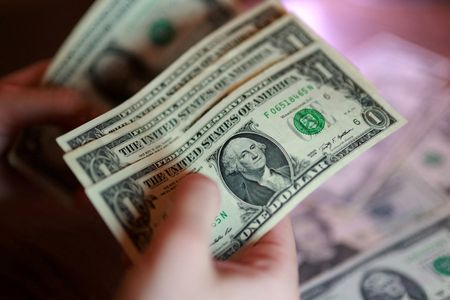
July 16 (Reuters) - The dollar hovered near its one-month low on Thursday as investors weighed subdued U.S. inflation data, which dampened rate-hike expectations, against the risk of a further oil price spike that could support the greenback.
U.S. Treasury yields fell on Wednesday after a second consecutive day of data pointed to moderating inflation pressures, undermining expectations for a Federal Reserve tightening move and support for the greenback.
The U.S. economy is less exposed to energy shocks than many of its peers, helping attract safe-haven flows into the dollar when oil prices rise, often at the expense of the euro and yen.
Conversely a diplomatic breakthrough in the Middle East tends to weaken the greenback against both currencies as lower oil prices improve the outlook for energy-importing economies.
Some investors said current flare-ups in tensions with Iran were intended to gain leverage in negotiations, and that the situation could ultimately be de-escalated once the United States had secured a stronger negotiating position.
“The market also takes note of the fact that Trump's threats, rhetoric and deadlines are rarely fulfilled,” Jens Magnusson, chief economist at SEB, said.
“When the price gets too high, primarily for oil and petrol, he backs down and the price falls back,” he added.
Oil prices turned lower on Thursday as traders took profits while assessing the risks from a new wave of U.S. strikes on Iranian military installations.
The U.S. dollar index, which tracks the currency against six peers, was little changed at 100.48, hovering near its lowest since June 18. It has fallen 0.8% over the previous two sessions and is on track for a weekly decline.
Chances for a Fed hike in July were slashed to 11%, versus a 45% implied probability at the start of the week. Markets still see even odds of at least a 25 basis-point increase in September, according to Fed funds futures prices via CME Group.
The euro was little changed at $1.1469. Investors are closely monitoring European gas futures, which have risen to their highest levels since March, stoking concerns that higher energy costs could weigh on the euro zone economy and limit further appreciation of the euro.
Sterling held near a two-month high at $1.354, little changed after economic data, with investors expecting that Britain's incoming prime minister will pick a fiscally conservative finance minister.
YEN UNDER THE SPOTLIGHT
The yen hovered near multi-decade lows, with attention on potential moves by Japan's Government Pension Investment Fund (GPIF) after Finance Minister Katsunobu Kato said last week the government wants a "substantial" increase in domestic asset investment.
The dollar rose 0.10% to 162. It hit a multi-decade high at 162.84 early this month.
"GPIF’s discussion signals that official-sector capital allocation is becoming an active policy tool rather than a long-term aspiration," Geoff Yu, senior EMEA macro strategist at BNY, said.
"Investors should treat this as the start of a multi-year structural theme, extending well beyond Japan," he added.
Analysts argued that GPIF has the greatest capacity among Japanese investors to influence the forex market. GPIF conducts a strategy review every five years and completed its latest one in 2025. However, it can still adjust its holdings within its target allocation bands.
The Australian and New Zealand dollars were both down about 0.1%, at $0.6995 and $0.5842 respectively.
(Reporting by Stefano Rebaudo, additional reporting by Jiaxing Li in Hong Kong; Editing by Christopher Cushing, Alexandra Hudson)
Find it fast
Looking for more insights? Explore our other news sections for updates on sustainable finance, companies and financial education