Dollar fades after touching one-week high as Iran deal in doubt
By Chuck Mikolajczak
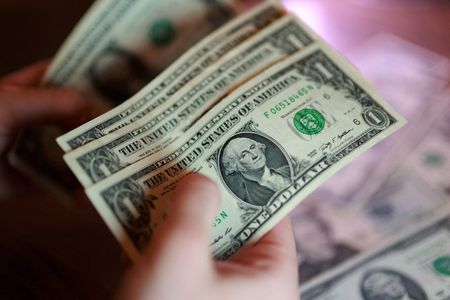
NEW YORK, July 8 (Reuters) - The U.S. dollar dipped after reaching its highest level in about a week on Wednesday after U.S. President Donald Trump said an interim memorandum of understanding signed with Iran to end their conflict was "over", while investors digested the minutes from the Federal Reserve's recent meeting.
Trump said an interim agreement to end the war with Iran was "over" and that the United States was likely to launch new strikes on Wednesday night following Iranian attacks on U.S. bases in the Gulf.
However, Trump also said he did not expect a return to full-fledged war, and it was not immediately clear whether the negotiations on reaching a permanent deal would carry on.
Oil prices jumped, with U.S. crude up 4.36% to $73.51 a barrel and Brent climbing to $78 per barrel, up 5.23% on the day. U.S. Treasury yields also climbed.
The dollar index, which measures the greenback against a basket of currencies, fell 0.2% to 100.98 after earlier climbing to 101.27, with the euro up 0.12% at $1.1425.
"The positioning is a little crowded on the long side, what that tells me is dollar strength is fully pricing in this idea that the Fed's going to get in here and raise rates and support rate differentials for the U.S. It's also largely priced in geopolitical risk," said Thomas Urano, co-chief investment officer at Sage Advisory in Austin, Texas, who also noted the greenback has seen strong gains from its late January low this year.
"It just leaves the dollar in a spot where it could be a little susceptible for corrections."
Expectations for a rate hike of at least 25 basis points from the Fed at its July meeting inched up to 30.5% from 26.7% in the prior session, while odds for the September meeting rose to 65.7% from 61.9%, according to CME FedWatch.
NEW ZEALAND HIKES RATE, FED MINUTES IN FOCUS
Meanwhile, the New Zealand dollar strengthened 0.49% versus the greenback to $0.5705 although it was off its earlier highs, after the Reserve Bank of New Zealand hiked rates by 25 basis points to 2.5% to curb inflation pressures, as most economists had expected. It said that "Some further reduction in monetary stimulus is likely to be required" to control inflation.
Analysts at Goldman Sachs said in a note that they see the start of a hiking cycle in New Zealand, "albeit a short one" as a positive for the currency "and part of the broader catch-up in macro conditions and monetary policy to many of its G10 peers."
Minutes from the Federal Reserve's June meeting, and first under new Chair Kevin Warsh, showed concern about high inflation mounted among policymakers, and a few participants at the June 16-17 meeting saw a case to raise rates right away.
"You kind of still have to lean a little bit to the risk that they have a chance for a rate hike later in the year," said Urano.
Against the Japanese yen, the dollar strengthened 0.23% to 162.46 and was on track for a fourth straight daily advance as traders remained on guard for signs of a possible intervention from Japanese authorities.
Sterling strengthened 0.37% to $1.3401 after hitting a three-week high of $1.341.
(Reporting by Chuck Mikolajczak; additional reporting by Sophie Kiderlin in London and Gregor Stuart Hunter in Singapore; Editing by Philippa Fletcher, Kevin Liffey and Chizu Nomiyama )
Find it fast
Looking for more insights? Explore our other news sections for updates on sustainable finance, companies and financial education