BOJ lifts rates to 31-year high, pivots towards preemptive inflation fight
By Leika Kihara and Makiko Yamazaki
TOKYO, Sept 18 (Reuters) - The Bank of Japan raised interest rates to a 31-year high on Friday, with its governor signalling the central bank has entered a new phase focused on preventing inflation from overshooting its target, opening the door to further rate hikes.
But the hawkish message failed to rally the yen. Instead, the currency weakened as investors seized on dissent from two policymakers who argued the BOJ should remain patient in raising borrowing costs.
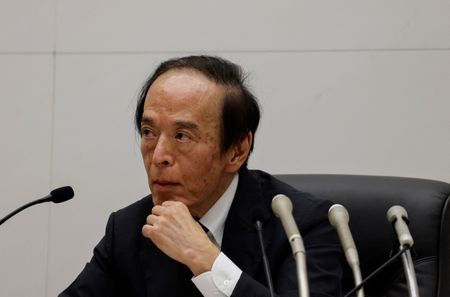
BOJ Governor Kazuo Ueda said with underlying inflation approaching 2%, the bank's focus had shifted from pushing prices up to target to guarding against an inflation overshoot.
"If risks of underlying inflation overshooting 2% materialise, that could have a negative impact on Japan's economy," he told a news conference.
"It's important to stabilise underlying inflation at 2%. Our policy phase has changed," Ueda said in his strongest remark to date on the central bank's resolve to combat price pressures through continued rate hikes.
Ueda said he would not rule out either back-to-back rate hikes or increases of 50 basis points. He stressed, however, that the BOJ aims to act preemptively to avoid being forced into large moves that could unsettle financial markets.
"Ueda's message appears to be that the BOJ is keeping its option of further rate hikes open and keeping close watch on inflation to stabilise it," said Vasu Menon, managing director of investment strategy at OCBC in Singapore.
"Overall, the BOJ's decision and Ueda's comments point to a modestly hawkish medium-term stance. However, the near-term message is not hawkish enough to trigger a significant repricing of the yen."
At the two-day meeting ending on Friday, the BOJ raised its policy rate to 1.25% from 1% by a 7-2 vote. Dovish board members Toichiro Asada and Ayano Sato, newcomers appointed by dovish Prime Minister Sanae Takaichi, dissented from the decision.
The move follows rate hikes by its European and US peers, highlighting central banks' focus on global inflation risks caused by the Iran war-induced energy cost spike, expansionary fiscal policies and surging demand for AI investment.
It was the first hike in three months and takes interest rates closer to levels the BOJ deems neutral to the economy, marking another step away from decades of ultra-low rates that cemented the yen's status as a cheap global funding currency.
The BOJ said while economic and price developments are moving in line with its baseline forecast, there was a risk of underlying inflation deviating from its 2% target.
"Wholesale inflation remains elevated and price pressures from business-to-business trading have started to spill over into consumer prices," it said in a statement.
The central bank also said financial conditions remained accommodative even after Friday's rate hike.
LAGGING PEERS
The BOJ exited a decade-long stimulus in 2024 and has raised rates several times, including in June, at a pace of roughly twice a year on the view that Japan was making progress in durably achieving its 2% inflation target.
Friday's hike to 1.25% brings the rate within the BOJ's estimated 1.1% to 2.5% range of Japan's nominal neutral rate, or the level that neither cools nor overheats growth, raising questions about how far it could eventually hike rates.
But the BOJ remains well behind its peers, with rates below the European Central Bank's 2.5% and the Fed's 3.75%-4.00% range. With other major central banks tightening, markets are focused on whether the BOJ will need to raise rates faster to curb yen-driven inflation.
Ueda said it was hard to pre-judge where Japan's neutral or terminal rates sat.
"We're in a phase where we need to look at various data carefully," he said. "But that doesn't mean we can move slowly."
"Governor Ueda sounded on the hawkish side," said Jessica Hinds, director of Economics at Fitch Ratings. "While he refused to be drawn on the specific pace of rate hikes or where rates will end up, this suggests to us that the acceleration in the pace of rate hikes is likely to be sustained."
Analysts polled by Reuters expect the BOJ to hike rates to 1.5% by end-March next year and to 1.75% in the second quarter of 2027. Most saw the terminal rate as being at least 1.75%.
POLITICAL COMPLICATION
Markets had nearly fully priced in a September rate hike after a slew of hawkish BOJ signals, including its warning in July of the risk of an inflation overshoot.
US Treasury Secretary Scott Bessent also piled in, voicing his support for "decisive" monetary steps to combat yen weakness in a meeting with Ueda this month.
Prime Minister Takaichi, meanwhile, has moved to cement her influence over economic policy, reappointing reflationist ally Minoru Kiuchi as economy minister, a role that grants him access to BOJ meetings.
While the two Takaichi-appointed dovish dissenters remain a minority in the hawkish-leaning board, such political factors may affect the pace of future BOJ rate hikes, some analysts say.
(Reporting by Leika Kihara and Makiko Yamazaki; additional reporting by Satoshi Sugiyama and Hina Suzuki; Editing by Sam Holmes and Shri Navaratnam)
Find it fast
Looking for more insights? Explore our other news sections for updates on sustainable finance, companies and financial education