Analysts and investors react to AI market rout
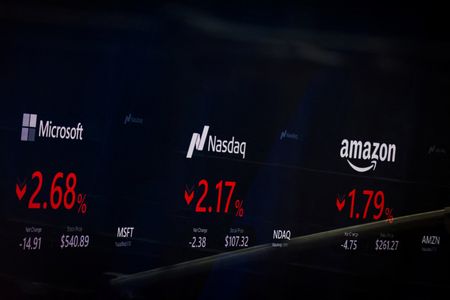
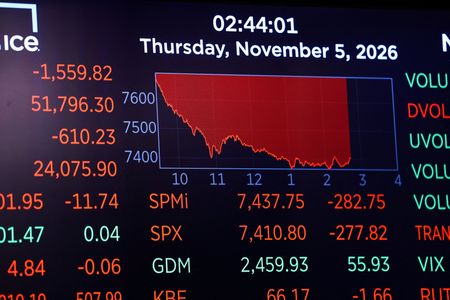
Nov 6 (Reuters) - Wall Street recovered some ground on Friday, a day after fears about tighter US regulation of AI wiped trillions of dollars off world stock markets and triggered a dash for government bonds.
The Nasdaq was up 1.5% on Friday, clawing back some of its 5.5% Thursday tumble, its biggest drop since the tariff-triggered "Liberation Day" rout in 2025.
On Friday in Asia, South Korea's KOSPI slumped 6% and Taiwan's benchmark slid 4.5% to notch its largest weekly fall for more than two decades. [MKTS/GLOB]
Here's what some market participants are saying:
MARK DOWDING, CIO FIXED INCOME, RBC BLUEBAY:
"Obviously the Democrat win puts a handbrake on the AI build-out and this may detract a bit from growth but the reality was that the AI part of the economy had been overheating, and so this may not actually be a bad thing. In this respect, markets had been straining under a deluge of debt and equity issuance and if this moderates, then it may suggest a somewhat more favourable outlook for AI related credit."
GUY MILLER, CHIEF MARKET STRATEGIST, ZURICH INSURANCE GROUP:
"While it may have a bit further to run, as levered positions are unwound, I suspect the sell-off is overdone. Tech has been weakening for some time, despite still remarkable earnings being posted, suggesting that there is not a lot of euphoria on the part of investors."
"Certain parts of the technology sector are now very cheap and continue to have good prospects ahead. I don’t believe the election outcome is transformational from an AI perspective. Regulation is needed and was expected to increase, but I think it is also in the interest of the Democrats to have a vibrant and leading AI industry in the US."
MATTHEW QUAIFE, GLOBAL HEAD OF MULTI ASSET, FIDELITY INTERNATIONAL:
"The scale of the move also appears to have been amplified by crowded positioning, leveraged investors and options-related hedging activity."
"Historically, technical selling of this magnitude can leave markets oversold, potentially creating opportunities to add exposure."
"Unlike previous cycles over the past few decades, the current AI investment cycle is driven primarily by capital expenditure rather than consumer spending. The nature of this cycle means it requires financing to sustain the same pace of investment, and therefore a technically driven sell-off can have an impact."
CHRISTOPHER FORBES, HEAD OF ASIA AND MIDDLE EAST, CMC MARKETS, SINGAPORE:
"It's actually a bit of a disaster.
"(Clients) were long index, long stocks, and they all got carried out.
"All night, all day – we had client margin calls, client complaints, ... because it's a very emotional thing, right? People are wedded to their positions and views on a stock or outcome and you're telling them, look, you've just lost money.
"And it's not just a slap in terms of valuation. It's basically a whole policy and six-year structural shift that says we're now going to pause, we're now going to cool AI, we're now going to cool data centres, approvals and equity capital markets."
DONG BAOZHEN, CHAIRMAN, LINGTONG SHENGTAI, BEIJING:
"The selloff shows that AI stock prices had been built on rosy illusions about the future, and now that illusion is gone," Dong said.
"The US stock market has been the standard-bearer and backbone of the global AI bull run. Now that backbone has snapped. Can AI bull markets elsewhere hold up on their own?"
JASON LUI, HEAD OF APAC EQUITY DERIVATIVES STRATEGY, BNP PARIBAS, HONG KONG:
"We are actually receiving more inquiries about looking at China onshore, because what we have noticed is that over the past month or so, the Chinese policymakers have stepped up on their stabilisation measures.
"Clients tend to view the China onshore trade as a potential diversifier from their global portfolio that tends to be more driven by US AI."
ALLEN HUANG, VICE PRESIDENT, MEGA FINANCIAL HOLDING EQUITIES TRADING DEPARTMENT:
"Today we are bound to see further liquidation of margin accounts, which suggests we are likely in the final stage of capitulation.
"Even TSMC hit its daily limit-down circuit breaker at one point, which typically marks the tail end of a downturn. When TSMC gets sold off, that means all stocks have been thoroughly dumped."
STEVE SOSNICK, CHIEF STRATEGIST, INTERACTIVE BROKERS, NEW YORK:
"Investors had already begun to question whether all the copious AI spending would reap sufficient returns to justify billions in debt and equity capital.
"When a group of stocks is heavily owned, priced to perfection, and critical to the bull market's thesis, there is not much room for error if their fundamentals appear threatened.
"After damage like the sort we've been facing, it is difficult to think that we simply can bounce from here. We may be oversold in the short term, but the underlying questions and causes can't simply be wiped away."
SHANE OLIVER, CHIEF ECONOMIST AND HEAD OF INVESTMENT STRATEGY, AMP, SYDNEY:
"Investors are trying to grapple with what the Democrat win might mean and they don't fully know yet. It attests to the broader concern that tech and AI-related trades were trading on relatively high multiples and that left them vulnerable. That concern had been building for a while now, and you could argue that the midterms provided the trigger for a pullback.
"It's too early to say the markets have bottomed, but providing the economic outlook is unaffected, it's probably going to be more of a correction than a bear market."
(Reporting by Rae Wee, Ankur Banerjee and Gregor Stuart Hunter in Singapore, Roger Tung in Taipei, Dara Ranasinghe and Karin Strohecker in London, Reuters Shanghai newsroom; Compiled by Tom Westbrook; Editing by Thomas Derpinghaus, Jacqueline Wong and Alexander Smith)
Find it fast
Looking for more insights? Explore our other news sections for updates on sustainable finance, companies and financial education