Explainer-Oil tops $100 on conflict worries. Why isn't it even higher?
By Florence Tan
SINGAPORE, Sept 9 (Reuters) - Global oil benchmark Brent crude hit $100 per barrel on Wednesday for the first time since late July, but the price rally has been relatively gradual despite escalating Middle East conflict driving fears of further disruption in oil shipments.
Roughly 9 million barrels per day (bpd) of crude and another 1 million bpd of refined products have been exported from the Middle East in recent days, Russell Hardy, CEO of Vitol, the world's largest independent oil trader, told the APPEC conference in Singapore on Tuesday.
That compares with roughly 20 million barrels of crude and products before the Iran war started on February 28.
Here are factors driving oil prices:
SIGNIFICANT VOLUMES HAVE BEEN ABLE TO FLOW THROUGH HORMUZ
In the week before fighting erupted again on August 30, roughly 8 million to 9 million bpd had been flowing through Hormuz, double the previous week's volume, said Rystad Energy's Chief Economist Claudio Galimberti, although shipments have fallen significantly since then, experts say.
During the interim U.S.-Iran peace deal in July, Hormuz crude exports touched pre-war levels of 16 million bpd.
GULF EXPORTERS ARE USING ALTERNATIVE ROUTES
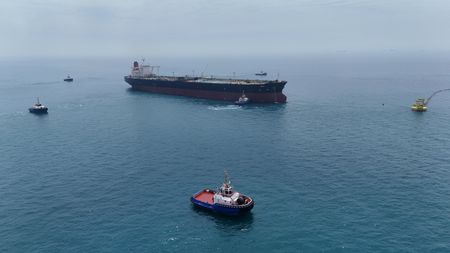
Gulf producers have found alternative routes and are expected to continue sending cargoes for ship-to-ship transfers outside of Hormuz, mitigating some of the earlier shortfall.
Saudi Aramco resumed loadings from its Ras Tanura port inside the Gulf in August, although its exports from Yanbu in the Red Sea remain under pressure from a naval blockade by the Iran-aligned Yemeni Houthis.
Yanbu exports hit a six-month low of 1.429 million bpd in August, from an average of 3.9 million bpd in the previous three months, provisional Kpler data showed, and attacks this week by Houthis on Saudi energy infrastructure could further threaten Red Sea shipments.
Exports from the alternative port of Egypt's Sidi Kerir hit 2.139 million bpd in August, more than double June volumes.
Exports from No. 2 OPEC producer Iraq rebounded in August to around 2.34 million bpd.
Shipments from the United Arab Emirates hovered around 2.9 million bpd in August and July after hitting a record in June, Kpler data showed.
Kuwaiti crude exports recovered to about 1 million bpd in July and August.
However, Iran's oil exports have fallen sharply due to the U.S. blockade.
OTHER PRODUCERS ARE STEPPING UP
Non-OPEC producers including the United States, Canada and Guyana are set to increase output by a combined 1.4 million bpd this year, according to Jarand Rystad, founder of Rystad Energy, partly filling the shortfall.
Meanwhile, Russian crude exports held steady at about 5.5 million bpd in July and August, down from the 6.4 million bpd peak in June, but still 23% higher than February as processing at Russian refineries has fallen due to damage to Russian plants from Ukrainian attacks, Kpler data showed.
However, Russia has downgraded its 2026 oil output forecast to a 17-year low, which may reduce its exports.
DEMAND DESTRUCTION IS SIGNIFICANT
Demand destruction in petrochemicals and transportation fuels remains significant in the third quarter at 3.5 million bpd, versus 4.5 million bpd in the second quarter, with China accounting for more than half of that due to rising transport electrification and coal-based chemicals, Rystad said.
Top importer China, dubbed the "new demand OPEC" for its market influence, slashed seaborne crude shipments to 7 million bpd in July and August, from over 11 million bpd in February.
China's oil demand is expected to fall by 600,000 bpd in 2026, or 8.9%, a third straight annual decline, Sinopec's research arm said.
Beijing's vast reserves, estimated by Kpler at 1.17 billion barrels, have also given markets comfort.
PHYSICAL AND PRODUCT MARKETS TELL A DIFFERENT STORY
Spot premiums have rebounded to April levels with Dubai and Oman at more than $20 a barrel above Dubai quotes for cargoes loading in November, Reuters data showed. Oman futures hit $121.68 on Wednesday.
"At the moment, it's telling us that physically things are incredibly tight," said David Fyfe, chief economist at Argus.
"We've already got prices substantially above $100 a barrel and even more important, you've got a diesel market that is screaming shortage."
The recent U.S.-Iran escalation is expected to curb Gulf exports while demand rises as refiners ramp output of diesel, which has hit a record high price in the U.S.
ANALYSTS LIFT FORECASTS
Several banks have raised their Brent forecasts, including Morgan Stanley, which expects prices averaging $100 a barrel in the fourth quarter, while HSBC on Tuesday raised its 2026 and 2027 Brent price forecasts to $90 and $85 a barrel, respectively.
Goldman Sachs has lifted its Brent and West Texas Intermediate forecasts by $5 a barrel for December 2026 and 2027, citing an expectation that Middle East shipping disruptions will persist into next year. It now forecasts Brent at $85 a barrel and WTI at $80 for December 2026, and 2027 prices at $80 and $75 a barrel, respectively.
(Reporting by Florence Tan; additional reporting by Siyi Liu; Editing by Tony Munroe, Lincoln Feast and Louise Heavens)
Find it fast
Looking for more insights? Explore our other news sections for updates on sustainable finance, companies and financial education