Fed's Warsh says past global savings glut is turning into investment surge
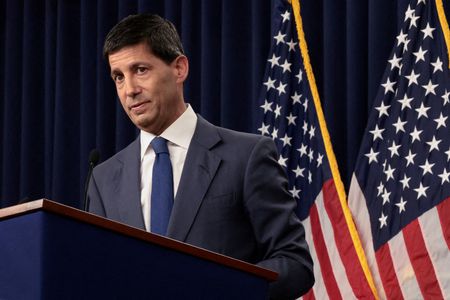
By David Lawder
ASHEVILLE, North Carolina, Aug 31 (Reuters) - U.S. Federal Reserve Chairman Kevin Warsh on Monday told G20 finance leaders that the world is seeing a global investment surge that is helping to power growth, reversing past savings gluts that kept capital in low-yielding instruments amid a shortage of investment opportunities.
Warsh, attending his first international economic policy meeting since taking the reins of the U.S. central bank in May, told the G20 opening plenary session that he was looking forward to learning more about growth prospects among member economies.
The Fed chief said that during past G20 meetings, even before the 2008 global financial crisis, and in years since, participants would have been discussing "a global savings glut," but the situation has reversed.
"If I were to try to characterize this moment, it would be one of a global investment surge," Warsh said at the meeting in Asheville, North Carolina. The notion of secular stagnation, the idea that growth will be much slower because of a lack of innovation, no longer applies in the current economy, he said.
Making rare public remarks by a Fed chief at a G20 or G7 meeting, Warsh came straight to the event from the annual central bankers' conference in Jackson Hole, Wyoming, where he said that the Fed would have "more work to do" if U.S. central bank policymakers do not get confidence that inflation is falling to their 2% target.
In Warsh's first substantive remarks on the economy, he came closer than he has previously to acknowledging interest rate hikes may be needed to ease price pressures.
Warsh told G20 finance ministers and central bank governors in Asheville that he is considering whether the U.S. and other G20 economies can grow faster than traditional forecasters, such as the U.S. Congressional Budget Office, have predicted — about 1.8% annually with "muted" productivity growth.
"The key question we have to ask is what's the underlying growth potential, and in particular, what's happening to productivity?" Warsh said.
MORE COMPETITION FOR TREASURIES
The shift in savings has created something of a bind for the Fed and U.S. Treasury.
The savings glut, first highlighted in the early 2000s by former Fed chief Ben Bernanke, had funneled savings into relatively low-return, safe investments like U.S. Treasury bonds. That trend helped keep U.S. government borrowing costs low, and allowed cheap mortgages for U.S. homebuyers.
But the emergence of other options, like the funding of massive bond issues to build artificial intelligence data centers and infrastructure, has been soaking up excess savings and is seen as one factor in rising U.S. Treasury yields and higher U.S. borrowing.
U.S. Treasury Secretary Scott Bessent told Reuters in an interview on Sunday that stronger economic growth was a factor in keeping yields higher, but dismissed concerns about the health of the Treasury debt market or worries about U.S. public debt, which crossed the $40 trillion earlier in August.
(Reporting by David Lawder; Editing by Tomasz Janowski and Paul Simao)
Find it fast
Looking for more insights? Explore our other news sections for updates on sustainable finance, companies and financial education