The battle to build a global defence bank
By Iain Withers, Elisa Martinuzzi and Lefteris Papadimas
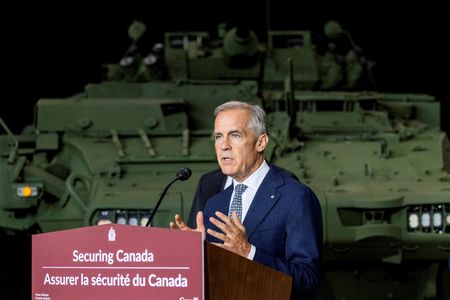
LONDON, Aug 30 (Reuters) - Canadian Prime Minister Mark Carney has thrown his weight behind a new global defence bank intended to help allies rearm, but other major economies have yet to commit just weeks before prospective members are due to sign up.
The Defence, Security and Resilience Bank (DSRB) has been seeking to raise around €100 billion ($116 billion) and use the money to lend at low cost to governments and contractors for defence projects. It will also offer guarantees for lenders financing smaller firms seen as riskier borrowers.
Alongside Canada, where the DSRB will be based, Albania, Belgium, Greece, Latvia, Luxembourg, Romania, Turkey and Ukraine have pledged their support.
Two officials from countries involved in the project said the DSRB had secured about €5 billion in commitments by August. It is aiming for around €20 billion in paid-in capital and a further €80 billion it can tap when needed, one of them said.
But Germany, Britain and other G7 countries have so far declined to join, raising questions over whether the DSRB can achieve the triple-A credit rating it wants to help secure the lowest funding costs.
"To make a good impression on the ratings agencies, they would need to have several other substantial governments participating," said William Perraudin, managing director at Risk Control, an analytics firm specialising in multilateral institutions.
Reuters spoke to eight people with knowledge of the discussions to join the bank. Some said that whether the DSRB can offer cheaper financing than highly rated national governments was a stumbling block for some potential members.
The amount of capital countries would need to commit while public finances are strained, the bank's governance, and overlaps with existing initiatives were also cited as factors.
Canada says it is talking with many countries ahead of a charter signing that its lead negotiator for the DSRB, Isabelle Hudon, said on the sidelines of July's Farnborough Airshow was planned for the autumn.
"We are proceeding at pace, developing Articles of Agreement and working with allies and partners alike to form a group of founding nations," said John Fragos, press secretary for Canada's finance minister.
REARMAMENT PUSH
Speaking at Farnborough on a panel dedicated to defence investment, DSRB founder Rob Murray said the lender would help countries rearm to counter mounting security threats.
"We need 10 of them, frankly," the former British Army officer and NATO innovation chief said.
European countries are increasing defence spending after the Trump administration demanded they take on more of NATO's burden, although few are close to meeting the alliance's latest targets.
Carney earlier this year called for an alliance of "middle powers" to respond to what he sees as the fracturing of the U.S.-led world order.
The DSRB will "ensure that Canada and our Allies have the capacity to meet the challenges of a more dangerous and divided world together", he said in July.
Perraudin said the DSRB could use financial leverage separate from the balance sheets of already indebted nations to boost defence investment. To become a significant player, however, it would need additional sovereign backing beyond current commitments, he said.
While big European economies can already borrow cheaply, membership would ensure their domestic contractors can access the DSRB funding, said Linus Terhorst of the Royal United Services Institute (RUSI) think tank.
COMPETING INITIATIVES
Five of the people with knowledge of the talks about DSRB membership cited potential overlap with other financing efforts, including the EU's SAFE programme and Britain's proposed Multilateral Defence Mechanism.
The European Union launched its €150 billion SAFE (Security Action for Europe) defence financing programme in 2025, while Britain is developing a Multilateral Defence Mechanism (MDM) with the Netherlands, Finland and Poland focused on joint procurement.
One official also cited concerns about the upfront capital required from governments, as well as uncertainty over how projects would be selected. Larger countries have been asked to put forward around €1 billion, two people with knowledge of the plans said.
In emailed comments to Reuters, Murray said this could be paid over three years and would in time return profits through dividends, while the DSRB would provide a more permanent institution for financing defence than SAFE and could work with any procurement method.
"If we do this properly, higher defence expenditure can generate technology, factories, skilled jobs, stronger supply chains and economic growth while simultaneously strengthening deterrence," Murray said.
WOOING BRITAIN
Canada hopes Britain could reconsider under new Prime Minister Andy Burnham, whose defence minister Wes Streeting described the DSRB at Farnborough as a "really interesting and innovative mechanism". He also said he did not see the proposed defence bank and MDM as being in competition.
Britain previously declined to join, citing concerns over value for money. According to his Downing Street office, Burnham discussed the DSRB alongside the MDM scheme with Carney in July and with Luxembourg Prime Minister Luc Frieden during an August visit to Kyiv.
"The UK joining would create pressure from German industry on the German government to join," said RUSI's Terhorst.
A German finance ministry spokesperson said its position on the DSRB had not changed since July, when it told Reuters it had taken part in DSRB talks as an observer and was reviewing the outcome. Japan's foreign ministry told Reuters no decision had been made about participating.
British and German industry groups have lobbied their countries to join. Andrew Kinniburgh of Make UK Defence said companies risked being excluded from projects financed through the bank if Britain stayed out.
CHASING A TRIPLE-A RATING
About a dozen banks including JPMorgan and Deutsche Bank have provided some $10 million in funding or services in kind to help establish the DSRB, according to a person with knowledge of the matter. The lenders, which could earn millions in fees arranging DSRB-funded projects, also backed an advertisement in the Financial Times newspaper saying the project had "the hallmarks of a future AAA-rated multilateral financial institution".
JPMorgan and Deutsche Bank declined to comment.
Canada's Hudon said at Farnborough that she was confident the DSRB could get a triple-A rating. Murray said a multilateral bank's rating depends on many factors and often exceeds the average rating of members.
Ottawa is prepared to launch the bank with the current group of supporters, one person involved in the project said, with other countries free to join later. That could help cement the rating it wants.
"The creditworthiness of multilateral institutions is principally driven by the support of their core shareholders," said Elisabeth Rudman, head of financial institution ratings at Morningstar DBRS.
($1 = 0.8590 euros)
(Additional reporting by Marc Jones, Elizabeth Piper, Alistair Smout, Karin Strohecker, Kate Holton, Jonathan Spicer, Maria Cheng, Jesus Aguado, Promit Mukherjee, Andrew Gray, Maria Martinez, Lili Bayer and John Geddie; Editing by Anousha Sakoui and Catherine Evans)
Find it fast
Looking for more insights? Explore our other news sections for updates on sustainable finance, companies and financial education