US-Iran war spurs Europe, Asia to boost renewables

By Kate Abnett, Nina Chestney and Sudarshan Varadhan
BRUSSELS/LONDON/SINGAPORE, Aug 26 (Reuters) - Six months into the U.S.-Israeli war with Iran, governments across Europe and Asia are scrambling to accelerate a renewables build-out in a bid to cut dependence on fossil fuel imports, providing a fresh impetus to the global energy transition.
As the effective closure of the Strait of Hormuz has choked off a fifth of the world's oil and liquefied natural gas (LNG) shipments, governments from South Korea and Thailand to the European Union have pledged to increase funding for renewables.
Has the conflict delivered a boon to the clean energy transition? Here are some ways to measure the impact.
RENEWABLES ARE SURGING, BUT COAL IS ALSO UP
Renewable power output is soaring across the world, and the International Energy Agency (IEA) expects it to become the top electricity source for the first time this year.
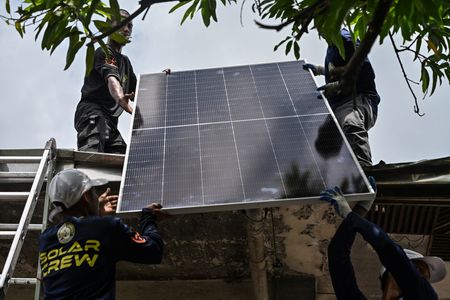
Since the war began, rooftop solar has proved attractive because it is quick and cheap to install. In the Philippines, high power prices driven by costlier imported fuel are pushing households and businesses onto solar, while a battery subsidy scheme is fuelling a rooftop resurgence in Australia.
European demand for rooftop systems has also jumped since the war began.
But coal is rising too. With the Strait of Hormuz closed and renewables still unable to guarantee round-the-clock power, coal-fired generation is set to grow — though the IEA's forecast 8.5% jump in renewable output this year dwarfs the 1.4% rise in coal.
In the United States, where President Donald Trump has opposed green energy, renewable generation rose 10% in the first half of the year from the same period in 2025.
EMISSIONS ARE STILL CLIMBING
Even as renewable generation surges, the IEA expects emissions of the greenhouse gases that cause climate change to rise 1.1% this year to an all-time high of 14.2 billion tonnes.
In 2027, the IEA expects coal output to dip by 0.7%, but gas-fired power generation to rise 1.5% from this year's levels. Curbing climate change will require even more renewable energy and investments in power grids and energy storage.
ASIA BEARS THE BRUNT
Asian economies most dependent on oil and gas through the Strait of Hormuz have absorbed the sharpest shock.
China leaned hard into solar, with output rising more than three times as fast as coal between March and July. India, Vietnam and South Korea went the other way, burning more coal. Some European countries also saw extra coal burn, but the IEA expects EU coal generation to resume its decade-long decline in 2026.
Last month, the Vietnamese government said it was considering building more coal plants to secure supply — despite pledging at the 2021 U.N. climate summit to build no new coal after 2030.
TRANSPORT
Most of the world's oil is burned as transport fuel — in cars, trucks, ships and planes. The war has not collapsed that demand, but it has reversed the growth forecasters had pencilled in.
Higher prices, reduced air travel, softer Chinese consumption and faster EV adoption mean the world is now likely using less oil for transport than projected before the war. Goldman Sachs estimates gasoline-related demand fell about 20% at the April peak of the disruption; GL Consulting puts the drop nearer 15%.
Costlier fuel has pushed drivers toward EVs, and China — the world's biggest maker — has seen its EV export value top $10 billion for the first time this year.
Electric models made up 63% of the country's passenger-car retail sales in June, up from 53% a year earlier, according to BofA analysts, who estimate electrification explains roughly a third of China's year-to-date decline in crude imports.
EV sales have also soared across Europe since the war began as high oil prices have caused pain at the pump.
HOW LONG WILL IT LAST?
As long as Hormuz stays shut, high oil and gas prices are likely to persist, strengthening the case for countries to invest in cheaper, home-grown renewables and reduce their exposure to volatile fuel costs. But whether a shift away from oil and gas gathers even more momentum is difficult to predict.
"Changing a nation's energy mix requires investments, and higher interest rates will make the considerable upfront capital required for renewables and power grids more expensive. Thus, while the present conflict is likely to ultimately favour decarbonization, it is not a one-way street," said Sverre Alvik, vice president and energy transition outlook director at DNV.
Many large Asian markets have substantial gas and coal resources to provide a buffer against Middle East supply disruptions and a lot more U.S. LNG supply is expected to come online between 2026 and 2030.
"As this supply materialises, LNG should become more affordable for import-dependent Asian markets, reducing the incentive for a permanent shift away from gas driven solely by the current conflict," said Victor del Carpio Neyra, senior research associate at Aurora Energy Research.
(Reporting by Kate Abnett in Brussels, Nina Chestney in London and Sudarshan Varadhan in Singapore; Editing by Conor Humphries)
Find it fast
Looking for more insights? Explore our other news sections for updates on sustainable finance, companies and financial education