Norway will drill in Arctic regardless of EU's position, says energy minister
By Nora Buli and Nerijus Adomaitis
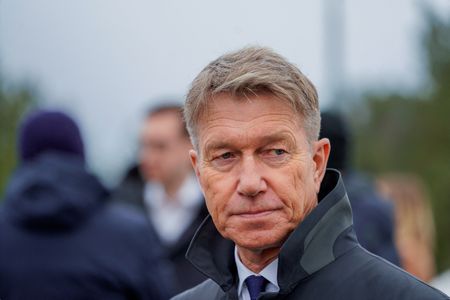
STAVANGER, Norway, Aug 24 (Reuters) - Norway will continue developing its oil and gas resources in the Barents Sea regardless of the European Union's support for a moratorium on Arctic hydrocarbon supplies, and no longer sees itself as Europe's "green battery", Energy Minister Terje Aasland told Reuters.
Following Russia's 2022 invasion of Ukraine, Norway has become Europe's largest supplier of natural gas, meeting around 30% of gas demand of both the European Union and Britain.
Last year, the country's gas production was near record levels, while oil output reached its highest level since 2009. Official forecasts, however, show production falling sharply after 2030 unless new resources are discovered and developed.
"In today's geopolitical and security environment, and given the resource situation, I believe continued activity in the Barents Sea serves both Norwegian and European interests," Aasland said in a Reuters interview ahead of ONS, Norway's biannual energy conference, which begins in Stavanger on Monday.
The European Union currently supports a ban on new drilling in the Arctic on environmental grounds but is considering revising its policy in response to concerns about energy security.
RISK OF STRANDED ASSETS, GREENPEACE SAYS
Aasland's statements show that Norway is disregarding major EU initiatives in renewable energy and grid expansion to cut the bloc's dependence on fossil fuels, environmental campaigners said.
"Fields discovered today risk coming on stream just as European gas demand is falling sharply, raising an obvious risk of stranded assets," Greenpeace policy advisor Paal Frisvold told Reuters.
However, Norwegian energy companies said on Monday they were still pushing ahead with more drilling, hoping to make major new discoveries.
Anders Opedal, CEO of Equinor, Norway's biggest oil firm, said oil and liquefied natural gas (LNG) from the Barents Sea can be shipped anywhere in the world if rejected by the EU.
"The only thing that will suffer from this is actually European security. We have the flexibility," Opedal told Reuters on the sidelines of the ONS conference.
NORWAY AIMS TO MAINTAIN OUTPUT LEVELS
Aasland said Norway aims to maintain petroleum production and exports at roughly current levels until at least 2035, and Barents Sea production will be key.
"If Norway is to remain a long-term supplier of oil and gas to Europe..., then the Arctic must be part of that discussion," the energy minister said.
In talks with EU officials, Norway has argued that the parts of the Barents Sea opened to petroleum activity are also ice-free like in the North Sea, and so less prone to oil spills and other environmental impacts, and are helping to sustain jobs and settlement in the country's northern regions bordering Russia.
Aasland believes Norway's arguments are being heard in Brussels, but added that it was the country's sovereign right to develop the Barents Sea resources even if the EU continued to support a moratorium.
"We would develop these areas, and then it will be up to the EU whether they should have a moratorium on buying that gas or oil," Aasland said.
Arctic oil would be sold into global markets regardless, while gas could be exported worldwide as liquefied natural gas from Equinor's Melkoeya LNG plant near Hammerfest, he added.
International Energy Agency Executive Director Fatih Birol has also urged the EU to reconsider its opposition to new Arctic oil and gas developments, arguing that future supplies will be needed to support energy security.
Critics of such a move argue that new Arctic projects would take many years to come online and would do little to address Europe's near-term energy challenges.
GREEN BATTERY "A FLAWED IDEA"
In addition to oil and gas, Norway produces a surplus of renewable energy most years from an extensive network of reservoirs and waterways feeding hydroelectric plants, which it has exported to Europe via cross-border power cables.
Norway has previously presented itself as "the green battery" of Europe, but the minister says this idea is now outdated as Norway alone can't balance the European power market.
"It was a flawed idea," Aasland said.
The idea helped drive the construction of new power interconnectors, including links to Britain and Germany, but has drawn some opposition in Norway as European electricity prices have escalated.
Deeper integration with Europe's power system left Norway more vulnerable to continental price swings.
Aasland said Norway will not build new interconnectors but remains committed to strong power sector cooperation with Europe.
He urged countries on the continent to strengthen their stable power supply, weakened by coal and nuclear plant closures and a lack of investment in new gas-fired generation.
Doing so will lower prices and build greater reciprocity when it comes to power flows between different countries.
"The future lies in having a very strong and integrated system," Aasland said.
(Reporting by Nerijus Adomaitis and Nora Buli; Editing by Susan Fenton and Tomasz Janowski)
Find it fast
Looking for more insights? Explore our other news sections for updates on sustainable finance, companies and financial education