Air taxi developers pivot to military market amid civil certification delays
By Shivansh Tiwary and Dan Catchpole
July 31 (Reuters) - Aerospace startups that have long promised to develop electric air taxis are increasingly focusing on a market with fewer regulatory hurdles and more money to spend: the military.
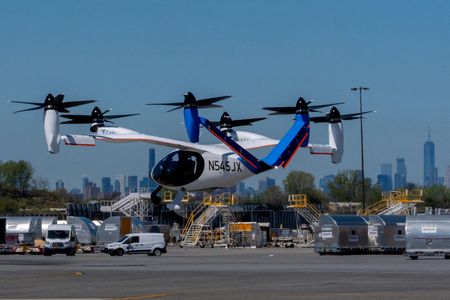
At last week's Farnborough Airshow, several of the biggest companies vying to get an electric vertical take-off and landing aircraft (eVTOL) to market talked up new efforts to develop military versions of their aircraft, a pivot from the Jetsons-style future with air taxis zipping commuters around that they had pitched to investors.
Turning that vision into commercial reality is taking longer and costing more than companies and investors expected.
In the meantime, wars in Ukraine and the Middle East have increased military demand for uncrewed aircraft that do not need a runway, are cheaper to deploy than traditional models and can perform multiple types of missions, including supply, surveillance and medical evacuations.
"Investors are excited about defense, because the industry is expanding rapidly and products can be fielded without the lengthy civil regulatory process," Archer Aviation CEO Adam Goldstein said at Farnborough.
"The time to field can be much shorter, and if you win a program there is known money at the end of the contract — very different from a new product category like (a civil) eVTOL," he said.
During the air show, Archer unveiled an unmanned hybrid-electric aircraft capable of combat and logistical missions developed with Anduril.
Vertical Aerospace's tiltrotor prototype completed a transition flight at Farnborough, taking off with the rotors pointing like a helicopter. In the air, the rotors tilted forward and the aircraft flew like an airplane.
However, just before the show, the UK-based company had again pushed back its goal for certification and entry into service for its Valo aircraft by another year to 2029. As recently as three years ago, its target was 2025.
Like its competitors, Vertical Aerospace's share price has dropped more than 50% in the past year.
"This is a volatile and risky sector, since it's contingent on (regulatory) certification and contingent on developing and integrating a technology that is new and that is innovative," said Andres Sheppard, a senior investment analyst at Cantor Fitzgerald.
"There are some sets of investors who are becoming perhaps a little bit less patient," he said.
Sheppard said he was still confident that eVTOLs will come to market by the end of the decade, but in the meantime, "these companies have to fortify their balance sheets."
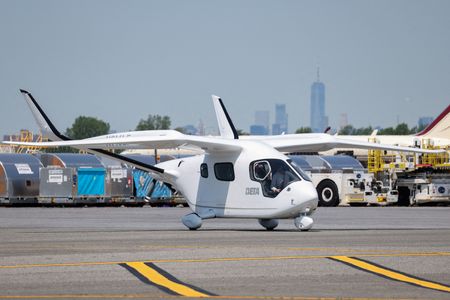
While competitors are pivoting, Beta Technologies has been developing military and civil versions of its Alia eVTOL for several years. The unmanned military version of Alia, the MV250, was on display at the show.
"Beta has focused on making sure that our defense product is identical to our commercial product," Beta CEO Kyle Clark said in an interview during the air show. "So, the motors, the rotors, the flight controllers, all the pieces in it are the same between the two products."
The company has simultaneously developed the two products, as well as an electric conventional take-off and landing (CTOL) Alia model, as a way to reduce costs and development time.
"That's when you get that strategic advantage of doing both together, and that becomes an accelerant, not a drag or a distraction, but an accelerant to our commercial product," he said.
At the show, Beta announced that UK regional airline Loganair had placed five provisional orders, plus options for five more, for the CTOL version, with commercial service beginning in 2029.
Sheppard said he expected the CTOL version to become the first commercial electric aircraft certified by the U.S. Federal Aviation Administration as soon as mid-2027, followed by the eVTOL version in 2028.
(Reporting by Shivansh Tiwary and Dan Catchpole; Editing by Jamie Freed)
Find it fast
Looking for more insights? Explore our other news sections for updates on sustainable finance, companies and financial education