World stocks fall in semiconductor rout; oil rises on Middle East escalation
By Sinéad Carew and Samuel Indyk
NEW YORK/LONDON, July 17 (Reuters) - Share indexes tumbled around the world on Friday, as heavyweight chip stocks plunged for a third consecutive day as investors reduced bets on artificial intelligence, with China's Moonshot releasing a large AI system.
Meanwhile oil prices rose to their highest levels in more than a month as the United States and Iran risked further escalation as they expanded their attacks to hit key infrastructure. The United States struck bridges in Iran, and Tehran responded by hitting a power and desalination plant in Kuwait.
In the contested Strait of Hormuz, where the renewed conflict has again cut off global energy supplies, U.S. Marines boarded a tanker, and another ship was reported to have been hit by a projectile.
In its third straight day of losses, the Philadelphia semiconductor index ended down 1.6% on Friday, putting it 20% below its most recent record close, reached on June 22, after earlier falling 23.5% below the record.
Adding fuel to existing worries about rich valuations and the sustainability of AI capital spending growth was the unveiling by Chinese AI startup Moonshot of Kimi K3, which it said was the world's largest open-weight AI system, delivering performance close to U.S. giant Anthropic's frontier model.
Wall Street's indexes pulled away from their session lows early in the day as some investors "felt this would be a good time to at a minimum start aggressively covering some recent shorts, or do some buying," according to Michael James, managing director and equity sales trader at Rosenblatt Securities.
But he described the market as "extremely emotional and sentiment driven."
"We're still down on the day and that's not going to instil confidence come Monday morning. It's a very shaky environment right now," he said.
On Friday, the Dow Jones Industrial Average fell 406.55 points, or 0.77%, to 52,146.42, the S&P 500 fell 76.08 points, or 1.01%, to 7,457.69 and the Nasdaq Composite fell 361.70 points, or 1.40%, to 25,520.24.
For the week, the S&P 500 ended down 1.55% while the tech-heavy Nasdaq fell 2.9% and the Dow lost 0.93%.
MSCI's gauge of stocks around the globe fell 13.17 points, or 1.17%, to 1,108.52 on the day.
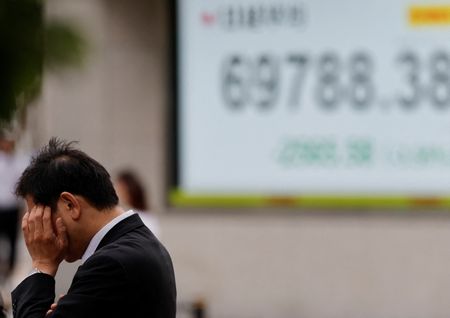
Earlier the pan-European STOXX 600 index ended down 0.34%. Losses were more severe in Asia, with MSCI's broadest index of Asia-Pacific shares excluding Japan finishing down 2.7%, while Japan's Nikkei tumbled 4%, putting it 12% below its recent peak.
In energy markets, U.S. crude settled up 4.48%, or $3.54, at $82.49 a barrel while Brent settled at $88.10 per barrel, up 4.59%, or $3.87 on the day.
Energy stocks were the only U.S. industry sector to gain ground on Friday. Also, Mona Mahajan, head of investment strategy and asset allocation at Edward Jones, noted that defensive assets such as government bonds were in demand, while safer equity sectors such as utilities fell less than higher growth industries.
In the bond market, longer-dated U.S. Treasury yields dipped on Friday after the latest round of economic data and were set for a weekly decline as markets have largely priced out any chance of a rate hike from the Federal Reserve at its policy meeting later this month.
The yield on benchmark U.S. 10-year notes fell 1.55 basis points to 4.554%, from 4.569% late on Thursday while the 30-year bond yield fell 2.39 basis points to 5.0731%.
In currencies, the dollar held steady on Friday but ended the week lower as tame U.S. inflation data led traders to cut bets on Fed rate hikes.
The dollar index, which measures the greenback against a basket of currencies including the yen and the euro, rose 0.05% to 100.76, with the euro down 0.03% at $1.1437.
Against the Japanese yen, the dollar strengthened 0.03% to 162.43.
In precious metals, gold rose on Friday, but was showing its biggest weekly loss in six as escalating U.S.-Iran tensions drove energy prices higher, fuelling inflation fears and expectations of eventual U.S. interest rate hikes.
Spot gold rose 0.99% to $4,009.19 an ounce while U.S. gold futures rose 0.79% to $4,017.20 an ounce.
(Reporting by Sinéad Carew, Samuel Indyk and Rae Wee; Editing by Thomas Derpinghaus, Kirsten Donovan, Kevin Liffey and Sanjeev Miglani)
Find it fast
Looking for more insights? Explore our other news sections for updates on sustainable finance, companies and financial education