US futures bounce as Asia scrambles to shore up stocks after AI-driven rout
By Tom Westbrook
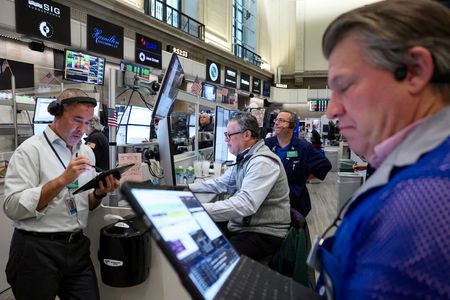
SINGAPORE, Nov 23 (Reuters) - US stock futures rose on Monday while authorities readied to prop up sliding stock markets in Asia, after a wipeout last week for the tech and chip stocks at the centre of the AI boom.
Investors are questioning whether the vast sums of mostly borrowed money spent building data centres to power AI tools will generate profits large and fast enough to repay lenders.
Last week's 10% drop in the Nasdaq was its largest weekly decline since pandemic panic gripped markets in March 2020, while the fall in Taiwan's chipmaker-heavy benchmark was the biggest since 1990.
On Monday, Nasdaq 100 futures bounced nearly 3% in Asia and S&P 500 futures rose by 2%, while Taiwan stocks rose 2%. European futures were steady.
But the rout deepened for South Korea's KOSPI index, which fell about 5% to a 10-month low. [.KS]
The KOSPI was global equities' leading light in the first half of this year, as bets on chip demand more than doubled the index's value in six months.
In the reckoning, the index has halved from its peak and South Korea's finance minister on Monday reiterated plans to stabilise the market, if necessary, which helped to steady shares.
Taiwan's financial regulator has ordered a tightening of short-selling rules for stocks, while in China, stock exchanges announced a batch of support measures such as easing requirements for margin financing.
"We need to be a bit careful here," said portfolio strategist Damien Boey at Wilson Asset Management in Sydney.
A suite of mood indicators he tracks showed US markets spent three sessions in "panic" territory last week, he said. That can sometimes signal the worst is over, but in this case traders might have a hard time finding a reason for a turnaround.
"If you don't have a policy pivot (at central banks) then there's no catalyst for a risk appetite panic to turn into a durable bounce," he said, leaving investors jumpy and unsure.
Japanese markets were closed for a holiday on Monday but futures indicated selling pressure, while markets in Hong Kong and China sank to new multi-month lows. Bonds and the dollar, safe-haven assets that rose sharply on Friday, mostly held gains.
AI TRADE TURNS
For about four years since the launch of chatbot ChatGPT, the "AI trade" has lifted a wide range of stocks, from chip to switch and cable makers to electricity generators on the assumption of explosive growth in computing demand.
According to analysts, AI spending is staying solid, with Morgan Stanley forecasting a rise next year in hyperscaler capital expenditure of more than 70% to top $1.6 trillion.
But the mood in the market has shifted drastically.
The exit of Jensen Huang, the Nvidia CEO nicknamed the "godfather of AI", has called the chipmaker's strategy of financing some of its customers into question. The faltering debut of AI leader Anthropic, which on Friday closed 8.5% lower on its first full day of trading, showed traders turning fickle.
Over the year to date, a Hong Kong index of AI stocks spanning Chinese chipmakers and AI companies is down nearly 60%.
The next test, besides the price performance of US markets this week, will be the results and outlook from computer maker Dell on Tuesday and, next month, whether the US Federal Reserve raises interest rates as investors expect.
The dollar's strength lifted it above 159 yen briefly on Monday, kept the euro below $1.10 and pinned the mood-sensitive New Zealand dollar near a 17-year low.
(Reporting by Tom Westbrook; Editing by Edmund Klamann, Jacqueline Wong and Jamie Freed)
Find it fast
Looking for more insights? Explore our other news sections for updates on sustainable finance, companies and financial education