Factbox-What EU and UK have agreed to at summit
By Philip Blenkinsop
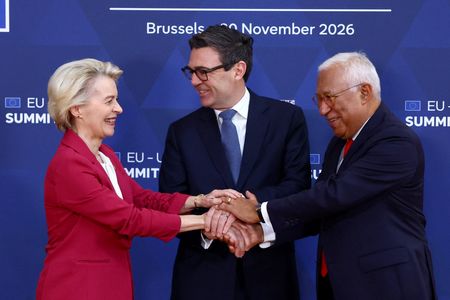
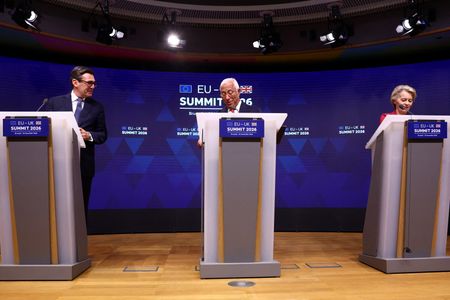
BRUSSELS, Nov 20 (Reuters) - Britain and the European Union reached agreements at a summit on Friday on easing food trade, on youth mobility and on linking each other's emissions trading systems.
Here are details of those agreements.
AGRI-FOOD TRADE
The most significant agreement economically will allow cross-border trade in animals, plants and related products, such as sausages, cheese, apples or seeds, without the certificates and controls currently required. Britain has estimated this could add up to £5.1 billion ($6.7 billion) per year to its economy. Consumers on both sides could benefit from lower prices. Travel for pets would also be easier.
The deal is due to come into effect in March 2028.
Logistics UK says cross-border shipments of animal or plant products from Britain to the European Union require health export certificates, which typically cost £150 to £250 per consignment. Many trucks have multiple consignments. Some consignments are subject to physical checks at the border by official vets.
Errors can lead to delays at the border, during which products may go off.
UK food, drink and feed exports to the European Union fell by 26% in value terms from 2019 to 2025, according to a House of Lords paper.
Under the deal, Britain would need to align with EU food and plant safety rules, an arrangement Brexit supporters oppose.
EMISSIONS TRADING
A further agreement would link the emissions trading systems of Britain and the European Union from 2028, which would exempt British and EU goods, such as steel, from each other's carbon border levies.
An emissions trading system sets a gradually decreasing cap on the amount of emissions that a sector, or group of sectors, can produce and creates "carbon permits" for those emissions, which companies must buy or hold for each ton of CO2 they emit.
Joining the two carbon markets would mean a carbon allowance from either can be used for compliance in either market. It will also increase liquidity in both markets and should pave the way for companies to be exempt from each other’s carbon border levies, designed to protect industry from producers abroad who don’t face similar green costs.
The EU's Carbon Border Adjustment Mechanism (CBAM) took effect in January 2026 and imposes an emissions fee on imports of steel, cement, aluminium, fertilisers, electricity and hydrogen. The UK will launch its own CBAM from January 1, 2027, covering the same sectors excluding electricity.
Britain says the emissions linking arrangement could add up to £3.8 billion a year to the UK economy, and exempt some £6.5 billion of exports from critical industries like steel and aluminium from paying the EU's carbon tax.
YOUTH MOBILITY
The two sides will allow in each other's young people initially aged 18-31 to work or study for up to three years by January 2030. Britain, mindful that immigration was a factor behind the Brexit vote, had proposed this should apply to 50,000 young people on each side. They finally agreed to 100,000 per year.
The two do differ over tuition fees, with EU countries wanting their students to be eligible for "home fees" at British universities, rather than the international rate, which is typically some three times higher. Britain prefers to offer "significantly reduced" fees.
The Russell Group, representing 24 research-intensive British universities, says granting home tuition fee status to EU students would cost UK universities £570 million.
The joint summit statement says Britain and the EU will resolve the issue within six months.
($1 = 0.7630 pounds)
(Reporting by Philip Blenkinsop; additional reporting by Susanna Twidale in London; Editing by Sharon Singleton)
Find it fast
Looking for more insights? Explore our other news sections for updates on sustainable finance, companies and financial education