Wall Street's AI bet: Own the infrastructure, collect the rent
By Arasu Kannagi Basil and Manya Saini
Oct 29 (Reuters) - Wall Street's top alternative asset managers are betting on the AI boom by owning the infrastructure behind it and locking in rent through long-term leases.
With concerns growing that debt-laden neocloud companies at the heart of the AI infrastructure boom could default and that massive spending on the sector may fail to deliver adequate returns, industry executives are also emphasizing their focus on high-quality, long-term tenants.
Blue Owl Co-CEO Marc Lipschultz said the company owns physical infrastructure critical to the growth of the digital economy.
"We typically lease it out for 15 to 20 years with annual rent escalators, creating a highly predictable and growing stream of rental income for our investors," Lipschultz said, adding Blue Owl focuses on limiting risks including those tied to short-term leases and token pricing.
Shares of alternative asset managers rose on Thursday, with Blue Owl up 6.5% and Ares Management gaining 2%. KKR and Blackstone each rose 2.5%, while Apollo Global gained 3.7%.
THE GREAT AI BUILDOUT
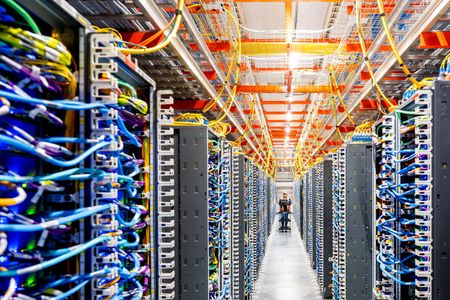
Data centers have become a critical part of the AI boom, housing the servers and computing equipment needed to train and run AI models.
As the world's biggest technology companies race to expand computing capacity, demand for such facilities has surged, creating what industry executives have described as a generational opportunity for alternative asset managers.
Blue Owl said it has more than 130 data centers operating or under construction, representing nearly 14 gigawatts of leased and owned capacity, with another 21 gigawatts in its pipeline.
"We are not making a bet on AI when we invest in data centers," Blue Owl CFO Alan Kirshenbaum said, adding that the company does not expect demand for computing power to decline. "We are taking Microsoft, Amazon, Meta, credit risk."
Ares Management said its data center development strategy focuses on metropolitan areas including Tokyo, Osaka, London and Sao Paulo, pre-leasing projects to investment-grade hyperscalers under 12- to 15-year leases with no termination rights and inflation escalators.
Blackstone last week also highlighted its focus on physical infrastructure and long-term contracted assets. The vast majority of its data center portfolio has initial lease terms of 15 to 20 years, with 96% of counterparties rated investment grade and an average market capitalisation of $2.5 trillion.
"So when we think about risk, that doesn't feel particularly risky to us," Blackstone President Jonathan Gray told analysts on a post-earnings call.
CAPEX BOOM
The AI spending spree across data centers, power, equipment and software is one of the biggest investment waves in history, rivaling those that accompanied the advent of the internet and the expansion of railways.
Ares estimates AI-related capex demand at just over $5 trillion through 2030, including roughly $2 trillion for physical data center buildings and adjacent power generation and transmission infrastructure.
Asked about the AI selloff earlier this month, Ares CEO Michael Arougheti said investors were becoming more discerning about counterparty risk and how to price it. He also downplayed the impact of higher borrowing costs on AI capex financing, saying the alternative would be to fund projects with equity.
"As the capex numbers have continued to scale, they went from largely equity-funded to then high-grade funded and now you're starting to see some of that funding demand flow through into the leveraged finance and private credit market. So there's an evolution here," Arougheti said.
Ratings agency Moody's said earlier this week that AI and digital infrastructure were creating large, long-duration financing needs that broaden the private credit market beyond traditional direct lending.
"Many borrowers and counterparties are investment grade. However, concentration, construction, residual-value and circular-financing risks are growing," Moody's said.
(Reporting by Manya Saini and Arasu Kannagi Basil in Bengaluru; Editing by Anil D'Silva)
Find it fast
Looking for more insights? Explore our other news sections for updates on sustainable finance, companies and financial education