Volkswagen plant's new recycling hub does little to ease closure fears
By Rachel More
ZWICKAU, Germany, Oct 28 (Reuters) - Volkswagen's all-electric car plant in Zwickau unveiled a new recycling facility for components on Wednesday, highlighting a potential future business line even as the site faces possible closure from the early 2030s under the group's restructuring.
Hit by the loss of its decades-long dominance in China and mounting competition from Chinese competitors in Europe, Volkswagen is pressing ahead with deep cost cuts, including plans for 100,000 job reductions and the possible closure of four German plants.
Zwickau is among the sites under threat, with no vehicle production currently planned beyond 2031, casting a shadow over Wednesday's launch of Volkswagen's first "Circular Economy Hub" at the factory in the eastern state of Saxony.
Volkswagen said 100 workers had been retrained and would begin dismantling 4,100 vehicles a year at the site from 2027.
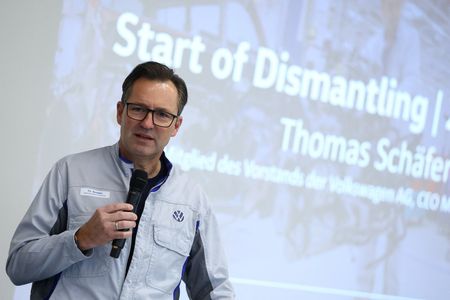
"For us, dismantling and recycling doesn't mean a junkyard — it means creating value," said Thomas Schaefer, the CEO of Volkswagen's volume brands.
A 'PILOT PROJECT' FOR NOW
The project was awarded to Zwickau in a bid to secure up to 1,000 jobs over the longer term. Volkswagen plans to invest up to €90 million ($100 million), while the regional government has pledged €10.7 million.
But the initiative offers only limited relief for a site where around 8,000 jobs are at risk under Volkswagen's overhaul announced in July. Production shifts are also expected to create excess capacity from mid-2026.
With support for the far-right opposition running high, Saxony's government is under pressure to protect an auto industry linked to one in four jobs in the state.
State Economy Minister Dirk Panter said the new facility showed Volkswagen was working with employees and the region to find durable solutions for the sector's future.
"The circular economy for automotive components opens up new business opportunities, creates additional value and offers long-term employment prospects," Panter said in a statement.
However, company sources and industry observers said the recycling venture alone would not secure the plant's future.
Henning Wilts, a circular economy researcher at Germany's Wuppertal Institute, said the Zwickau hub remained an experiment whose commercial viability had yet to be proven.
"This is a pilot project that you launch to see if it's scalable and if it's really an investment that will pay off quickly enough," Wilts said, adding: "It is certainly not the answer to all the questions in the European auto industry."
($1 = 0.8981 euros)
(Reporting by Rachel More. Editing by Mark Potter)
Find it fast
Looking for more insights? Explore our other news sections for updates on sustainable finance, companies and financial education