Poland to revive windfall tax on oil firms, use proceeds for fuel price relief
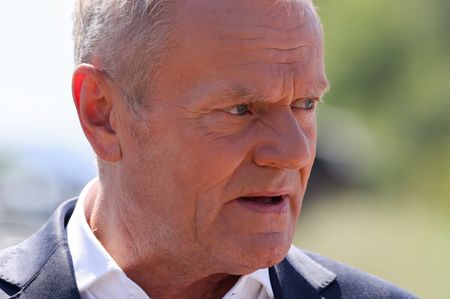
WARSAW, Sept 15 (Reuters) - Poland's government aims to push through a windfall tax on oil companies' excess profits and use the revenue raised to reduce fuel prices, Prime Minister Donald Tusk said on Tuesday, urging the country's president not to block it again.
The tax would impose a 60% levy on excess revenue generated by oil companies between March and December 2026, which the government says would generate 4 billion zlotys ($1.06 billion) a year.
The bill was previously rejected by President Karol Nawrocki, an ally of Poland's nationalist opposition, who referred it to the Constitutional Tribunal in July. The tribunal has yet to rule but the government has revived the bill and was due to approve it on Tuesday before submitting it to parliament again.
"I guarantee that if the president finally signs the recently resubmitted law on extraordinary profits, we will immediately implement another option to reduce fuel prices," Tusk said before a cabinet meeting.
"We shall see how far the funds go. But I hope no one has any doubts left that this bill must be signed. It is not the people who should pay for this fuel crisis. It is not the Polish people who are responsible for this fuel crisis."
In March, the Polish government introduced a fuel price-cap programme that ended in July and cost the budget approximately 4.7 billion zlotys. A lower VAT rate on fuel was also in effect during the last two weeks of August.
Turmoil in global markets during the Iran war has caused a sharp rise in fuel prices, benefiting fuel companies, primarily Orlen in Poland, which saw its revenue grow by nearly 26% year-on-year in the second quarter and its LIFO EBITDA jump by over 54%, according to a government document.
At the same time, consumers were grappling with a significant rise in fuel prices at petrol stations, while the transport sector faced higher costs. This also resulted in increased inflationary pressure.
($1 = 3.7602 zlotys)
(Reporting by Pawel Florkiewicz and Alan Charlish; Editing by Susan Fenton)
Find it fast
Looking for more insights? Explore our other news sections for updates on sustainable finance, companies and financial education