Trading Day: Pause before jobs
By Jamie McGeever
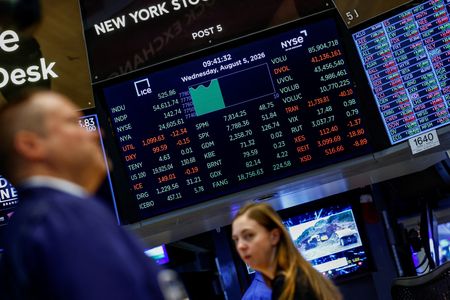
ORLANDO, Florida, Aug 6 (Reuters) - The S&P 500 and Dow on Thursday pulled back from the previous day's record highs, pausing their strong earnings-driven start to the month, while Treasury yields and the dollar rose as investors turned their attention to U.S. employment data on Friday.
In my column today, I look at the first of several SpaceX share lockup expiries and its potential impact on retail investors. They took up an unusually large 20% of the IPO, so are sitting on large paper losses. But they have significantly reduced their broader tech holdings and leverage recently, so may be tempted to add exposure.
If you have more time to read, here are a few articles I recommend to help you make sense of what happened in markets today.
1. EXCLUSIVE-Iran warns Gulf states: tell Trump to desist or we hit you hard
2. Fed's Daly says central bank was right to hold rates steady at July policy meeting
3. U.S. labor market stable; worker productivity accelerates in second quarter
4. U.S.-Japan action undercuts G7's historic FX role: Mike Dolan
5. Alphabet looks to raise up to $25 billion from latest bond sale, source says
Today's Key Market Moves
• STOCKS: South Korea -5%, Japan -1%. Europe, UK little changed. Wall St in the red: Dow -1%, S&P 500 -0.3%, Nasdaq -0.1%.
• SECTORS/SHARES: Eight sectors on the S&P 500 fall, three rise. Industrials, materials, real estate all down 0.8%. Energy +1.6%. Honeywell Aerospace -23%, Western Digital -13%. Motorola +8%, Disney +3%.
• FX: Dollar rises broadly for best day in two weeks. Yen has now given back almost half its post-intervention gains.
• BONDS: Japan yields fall, especially at long end, as 30-year auction goes better than 10-year sale earlier this week. U.S. yields up 4-7 bps, curve bear flattens.
• COMMODITIES/METALS: Oil rises, Brent +4%, WTI +3%. Gold little changed around $4,250/oz.
Today's Talking Points:
A job lot
July's U.S. employment data will be released on Friday. Non-farm payrolls is traditionally one of the data points that markets move most on, but this time might be different.
Employment indicators are a mixed bag right now; generally solid with some signs of weakness that ultimately paint a picture of broad stability. Fed policymakers agree that the labor market is in a highly unusual spot — a "low hire/low fire" stasis amid heightened AI uncertainty.
It's stating the obvious, perhaps, but it would need a major surprise to really jolt markets and move the needle on rate expectations, as the Fed is more focused on the inflation side of its mandate than the employment side. The few remaining Wall Street firms calling for Fed rate cuts, like Citi, say they anticipate a pretty rapid labor market deterioration in the coming months. Will we get a glimpse of that on Friday?
Intervention half-life
Debate around last week's historic yen intervention rages on. Washington's involvement was more symbolic than anything else, and despite pledges of solidarity with Tokyo, its appetite for further action is surely limited. Tokyo may have the stomach for more, and has the firepower, but Washington won't want to see Treasuries being sold. Also, the Fed's FIMA facility has limited capacity.
The yen has given back nearly half of its post-intervention gains, and we will see in the next few weeks how effective the intervention was. The debate will inevitably return to "fundamentals" — only a meaningful change in Japanese policy will ease the pressure on the yen over the long term. Rate hike expectations for the BOJ and Fed next month are similar, at around a 55% probability, and both central banks could be tightening into next year. Maybe "the fiscal" will need to do more of the lifting.
Special K
U.S. workers saw their share of the U.S. economy slide to a new low in the second quarter, figures on Thursday showed. This comes as the Q2 earnings season shows eye-watering U.S. corporate profit growth, with companies already enjoying a record share of the national economic pie.
This is another "K-shaped" feature of the U.S. economy that speaks to the perception that the wealthy and owners of capital are faring much better than everyone else. The rich can fuel stock market and GDP growth for so long, but Moody's Analytics economist Mark Zandi and others warn it's unsustainable. Consumers are noticing mortgage rates, gas prices and general inflation. So might voters in November.
What could move markets tomorrow?
• Japan household spending (June)
• Taiwan trade (July)
• Germany industrial production (June)
• U.S. non-farm payrolls (July)
• U.S. Richmond Fed President Thomas Barkin speaks
Want to receive Trading Day in your inbox every weekday morning? Sign up for my newsletter here.
Opinions expressed are those of the author. They do not reflect the views of Reuters News, which, under the Trust Principles, is committed to integrity, independence, and freedom from bias.
(Reporting by Jamie McGeever; Editing by Nia Williams)
Find it fast
Looking for more insights? Explore our other news sections for updates on sustainable finance, companies and financial education