Analysis-Samsung, SK Hynix shareholders call for bigger payouts from AI cash mountain
By Hyunjoo Jin and Kumar Tanishk
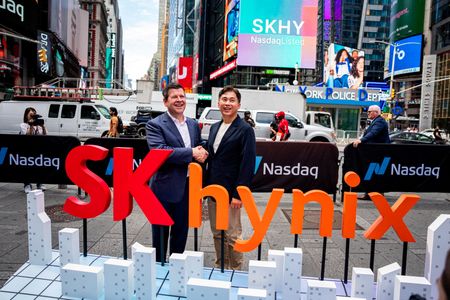
SEOUL, Aug 6 (Reuters) - Samsung Electronics and SK Hynix face growing calls from investors wanting a greater share of excess cash via dividends or buybacks, after the pair provided scant detail on capital returns when reporting AI-driven record profit.
The world's two largest memory chip makers are generating cash at an unprecedented pace due to robust demand for chips used in AI applications, amassing reserves that exceed those of U.S. tech giants that are spending heavily on AI infrastructure.
Samsung and SK Hynix are set to hold a combined $263 billion in net cash by year-end, more than double the estimated $102 billion of AI bellwether Nvidia and exceeding the combined cash of the other six "Magnificent Seven" U.S. technology companies, LSEG data and Reuters calculations showed.
AI frenzy has seen share prices of companies anywhere in the value chain soar spectacularly over the past year, but plummet equally spectacularly as euphoria over the technology's potential wrestles with concern over huge outlay and scepticism about corresponding returns.
With such companies reporting record profit, an absence of plans to commit to larger shareholder payouts could be interpreted as management being unconvinced about the durability of AI earnings, investors and analysts said.
In the case of Samsung and SK Hynix, the wait for payout plans stings all the more as the firms lag international technology peers such as Apple and TSMC in shareholder returns – sentiment exacerbated by broader investor discontent about the so-called Korea discount.
At present, both Samsung and SK Hynix target shareholder returns equivalent to half of free cash flow. In June, U.S. chipmaker Micron pledged to return 100%.
"If you stick to something around a 50% free cash flow return, you are going to end up with an incredibly inefficient balance sheet," said London-based portfolio manager Richard Clode at Janus Henderson Investors, whose fund owns SK Hynix shares.
"If you come out and say, 'Well, we're a bit unsure about the future, so we can't commit to a long term, big shareholder return program,' then you're just feeding the narrative that this is temporary, this is cyclical," he said.
During an earnings call last week, SK Hynix said only that it was considering additional measures to enhance returns and that it would share plans within this year.
"I was really infuriated after the call," said portfolio manager Kim Kyu-shik at Singapore-based hedge fund Vista Global Asset Management. "Shareholders were listening to the call for some sign of hope."
SK Hynix and Samsung shares have retreated around 48% and 37% respectively from record highs reached in June.
"I think they understand the urgency and the dislocation in the market today," said Clode, calling for an increase in SK Hynix returns to at least 80% of free cash flow.
JPMorgan analysts on Wednesday cut their target price for SK Hynix stock, saying a "clear stance on capital allocation is imperative ... to restore stock sentiment".
"Based on record-high cash generation capabilities, the company believes that it can meaningfully expand shareholder returns while maintaining investments and financial soundness," SK Hynix said in a statement.
Samsung said it is discussing its shareholder returns policy for this year and beyond and aims to share details "very soon".
"While we remain focused on maintaining a healthy balance sheet to manage cyclical risks and fund growth initiatives, we are also exploring ways to enhance shareholder returns in a sustainable manner," Samsung said in a statement.
DEMAND FOR SHAREHOLDER MEETING
Some investors have begun pressing for larger returns and increased efficiency in capital allocation including limiting employee bonuses.
"Retail investors are scared after the recent share-price plunge," said Lee Sang-mok, a representative at ACT. The retail investor platform this week launched a campaign to compel Samsung to hold an extraordinary shareholders' meeting and conduct a $32 billion share buyback.
"It seems like there is a lack of urgency at Samsung and SK Hynix."
Samsung has historically maintained a large cash reserve as the memory chip business is capital-intensive and prone to boom-and-bust cycles.
This year, Samsung and SK Hynix pledged a combined 3,200 trillion won ($2.07 trillion) in domestic investment to meet AI demand.
The pair are securing multi-year supply deals with major customers which should help them avoid the excessive capacity expansion that marked previous boom periods, freeing more cash for shareholder returns, said analyst Park Jun-young at Hanwha Investment & Securities.
"Given their expected cash generation, both companies should be capable of funding these investments while also delivering materially stronger shareholder returns," said Aadil Ebrahim, group head of equities at Klay Group. It was not a "binary choice" between investment and shareholder returns, he said.
EFFORTS TO ADDRESS KOREA DISCOUNT
The issue has broader implications regarding government efforts to address the Korea discount, or a tendency for Korean companies to trade at lower valuations than peers partly due to lower shareholder returns.
Ebrahim cited Apple's capital-return programme from 2013 as a precedent for a cash-rich technology company. At the time, the firm planned to return $100 billion through 2015 which included boosting a share buyback programme six-fold to $60 billion.
"Improving capital allocation could play an important role in narrowing that discount over time," Ebrahim said. Stronger shareholder returns could drive a long-term re-rating of South Korean equities, he said.
(Reporting by Hyunjoo Jin, Kumar Tanishk; Additional reporting by Heekyong Yang, Sameer Manekar and Ankur Banerjee; Editing by Miyoung Kim and Christopher Cushing)
Find it fast
Looking for more insights? Explore our other news sections for updates on sustainable finance, companies and financial education