Oil hits more than one-week low as pause in attacks supports hopes for US-Iran deal
By Anushree Mukherjee
July 28 (Reuters) - Oil prices extended losses on Tuesday, hitting their lowest levels in more than a week on cautious hopes for a resolution to the U.S.-Iran conflict as traders continued to assess developments in the Middle East.
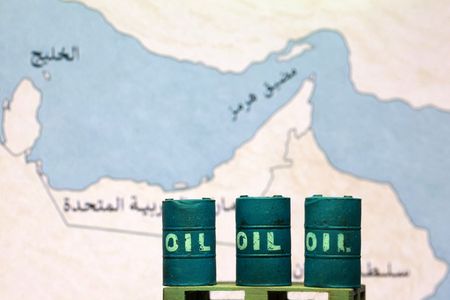
Oman has won backing from Gulf states for a plan that would let Tehran collect voluntary fees to use the Strait of Hormuz, a Gulf source told Reuters on Tuesday, a path towards ending the disruption to oil trade caused by the U.S.-Israeli war on Iran.
Brent crude futures were down $1.68, or 1.90%, at $86.68 by 1111 GMT. U.S. West Texas Intermediate crude was at $81.33 a barrel, down $1.28, or 1.55%.
Both benchmarks fell to their lowest since July 17.
U.S. President Donald Trump said on Monday Washington was having "good talks" with Iran and that there was the chance of a resolution. However, he said U.S. strikes would resume if negotiations failed, while Iran issued similar comments about retaliation.
"While flows of vessels through the Strait of Hormuz remain low, the market hopes the situation improves based on new talks between Oman and Iran on a new mechanism for Hormuz," UBS analyst Giovanni Staunovo said.
OMAN WINS GULF BACKING FOR HORMUZ PLAN, SOURCE SAYS
Oman has presented a proposal to Iran for a joint regional mechanism to manage the Strait of Hormuz with voluntary fees, a Gulf source told Reuters on Tuesday.
The Strait of Hormuz handles roughly a fifth of global oil consumption and is one of the world's most important oil shipping chokepoints.
The conflict has disrupted shipping beyond the Strait of Hormuz, with traffic through the Bab el-Mandeb strait linking the Red Sea to the Gulf of Aden also affected.
"The scale of the price drop is probably exaggerated and driven solely by hope. After all, shipping traffic through the Strait of Hormuz remains largely paralysed despite the temporary ceasefire," Commerzbank said in a note.
Prices surged last week on fears the attacks could lead to the closure of the Bab el-Mandeb route, the second-most important oil shipping chokepoint after the Strait of Hormuz.
However, the number of vessels passing through Bab el-Mandeb rose to 28 on Monday, a four-day high, while traffic through the Strait of Hormuz remained low, according to Kpler shipping data.
RISKS OF DISRUPTIONS TO RED SEA ROUTES STILL ELEVATED
Analysts warned the risks of supply disruptions spreading to the Red Sea remain elevated after Saudi Arabia said it shot down drones aimed at petroleum targets, including in Riyadh.
It said Iran-backed armed groups had launched the weapons from Iraq, and it reserved the right to respond.
Separately, Iran's Houthi allies in Yemen said they had targeted the East-West Pipeline carrying oil to Saudi Arabia's main Red Sea port of Yanbu in retaliation for Saudi drone incursions.
Goldman Sachs expects Brent to moderate to $80 by year-end if Hormuz fully reopens by the fourth quarter, but Red Sea disruptions and attacks on Saudi oil infrastructure may pose a new source of upside risk for crude and refined products prices.
Saudi Aramco shut down its 400,000-barrel-per-day Jazan oil refinery in Saudi Arabia on July 27 following an attack on Saturday, a note from consultancy IIR seen by Reuters showed.
(Reporting by Anushree Mukherjee and Ishaan Arora in Bengaluru and Siyi Liu in Singapore; Editing by Alexandra Hudson and Jan Harvey)
Find it fast
Looking for more insights? Explore our other news sections for updates on sustainable finance, companies and financial education