Strain grows on shipping industry with vessels stuck inside Hormuz
By Jonathan Saul
ATHENS, June 3 (Reuters) - Even if the U.S. and Iran agreed to halt the war and open the Strait of Hormuz, ships trapped in the Gulf will be unable to leave without safety assurances, the CEO of V.Group, a leading global ship manager, told Reuters.
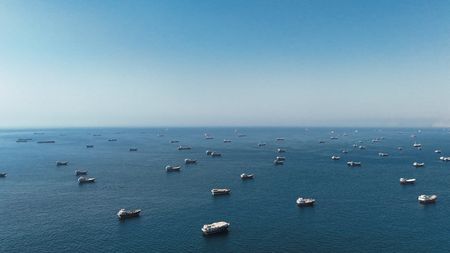
Renewed hostilities in the three-month-old conflict are testing a shaky ceasefire while hundreds of ships and about 20,000 seafarers remain stuck in the region with Hormuz largely closed.
V.Group, which manages around 800 vessels, has 13 ships stuck in the Gulf, half of them tankers, said Rene Kofod-Olsen, group CEO with one of the world's top technical ship and crew management specialists.
"You are in a situation where you supposedly have a ceasefire," he said during the Posidonia shipping week in Athens.
"But you still have kinetic activity." Kofold-Olsen said, referring to drone or missile strikes.
For traffic to return to pre-war levels, when on average 125 vessels passed via Hormuz daily, ship operators will need solid assurances of safe passage, in which the international community would need to be involved, he said.
"I don't believe that global shipping by definition will go through in a material way the Strait of Hormuz before those things are actually guaranteed," Kofod-Olsen said.
Shipping executives who gathered in Athens said that while crews in the Gulf were receiving supplies and it was possible to rotate teams inside the region, the strain from the conflict was deepening.
"Ship owners are having to operate in irregular frameworks, which can be difficult or challenging for the industry, difficult and challenging for insurers as well," Alex Gregg-Smith, president for marine and offshore with top ship safety certifier Bureau Veritas, told Reuters.
"It's putting pressure on the owners' operations."
Dwain Hutchinson, managing director of the Bahamas maritime registry, told Reuters there were 14 Bahamas-flagged ships, with over 900 seafarers on board, inside the Gulf, which included smaller offshore vessels that normally operated in the area.
While their safety and wellbeing were the top priority, the flag registry did not restrict ships from sailing into the region.
"We think that's an owner's decision and we hope that they will review the risk and take a balanced decision for operation in the region," he said.
Evangelos Marinakis, founder and chairman of Capital Maritime & Trading Corp, one of the world’s major tanker operators, said his group "were lucky enough" not to have had any vessels inside the Gulf when the conflict started on February 28.
"In case something happens, a casualty, we wouldn't be able to take such a risk," he told the TradeWinds ship owners' forum in Athens.
(Reporting by Jonathan SaulEditing by Tomasz Janowski)
Find it fast
Looking for more insights? Explore our other news sections for updates on sustainable finance, companies and financial education