Yen dips to 160 level, prompting warnings from Japanese officials
By Hannah Lang
NEW YORK, June 3 (Reuters) - Underlying dollar strength pushed the Japanese yen back to the key 160 level on Wednesday, prompting verbal warnings from authorities and keeping traders on alert for intervention, as fresh Gulf hostilities bolstered demand for the U.S. currency.
The U.S. said Iran launched ballistic missiles toward regional neighbors but all failed to hit targets, and that U.S. forces conducted strikes on Qeshm Island in response.
Diplomatic talks between Iran and the United States remain at a stalemate, keeping the market mood somber. The dollar has tended to rally during flare-ups of the conflict, underpinned by safe-haven demand and the U.S.' lower sensitivity to energy price shocks; the yen tends to weaken as oil rises, given Japan's reliance on imported energy.
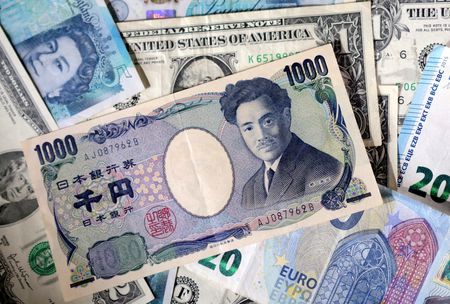
The yen on Wednesday fell to the closely watched 160 per dollar level, where authorities have previously intervened. That erased its gains made in the wake of Tokyo's 11.7 trillion yen ($73 billion) intervention a month ago to shore up the ailing currency.
"Everybody knows the risks of [Bank of Japan] intervention have increased, but it hasn't really deterred them," said Marc Chandler, chief market strategist at Bannockburn Global Forex.
"The intervention, which was a record amount, in late April and May, pushed us down, and we're back up there. So whatever the Japanese think they bought, they didn't buy that much time."
Prime Minister Sanae Takaichi said later that authorities stood ready to respond to exchange-rate moves as needed. Takaichi's verbal intervention supported the currency before a speech from Bank of Japan Governor Ueda, but the yen later returned to the 160 level.
Ueda said the central bank must discuss the pros and cons of raising interest rates if inflationary risks outweigh downside risks to the economy.
"Comments from BoJ Gov. Ueda have been hawkish, signaling that the policy rate was not in the neutral range," said Shaun Osborne, chief FX strategist at Scotiabank.
The dollar was last 0.07% stronger on the day at 160.015 yen.
Elsewhere, the euro eased 0.27% to $1.15995, while sterling was down 0.34% at $1.3419.
The prolonged war in the Middle East and persistently high energy prices have left investors ramping up bets of policy tightening across major central banks this year, a sea change from the rate cuts that were priced in prior to the conflict.
Against a basket of currencies, the dollar was up 0.223% at 99.516.
U.S. LABOR MARKET IN FOCUS
U.S. job openings increased by the most in five years in April, data showed on Tuesday. The key nonfarm payrolls are set for release on Friday.
"The nonfarm payrolls figure could be pretty important from a dollar perspective," said Gustav Helgesson, macro strategist at SEB. "It could tilt the Fed away from this easing bias and start eyeing rate hikes. I think it could be the start of a sentiment shift for the dollar."
Markets are pricing in roughly 19 basis points worth of Fed rate hikes by December, with a quarter-point hike fully priced in by March next year.
Elsewhere, the Australian dollar was 0.69% lower at 0.713, while the New Zealand dollar was 1.02% lower at 0.5865.
Bitcoin slid to a two-month trough and last traded 2.3% lower at $65,938, while ether similarly hit a more than three-month low and was last at $1,829.
(Reporting by Hannah Lang and Samuel Indyk; additional reporting by Rae WeeEditing by Peter Graff, Toby Chopra, Nick Zieminski and Nia Williams)
Find it fast
Looking for more insights? Explore our other news sections for updates on sustainable finance, companies and financial education