Sberbank sees Russian-issued stablecoins gaining ground for cross-border payments

By Elena Fabrichnaya and Gleb Bryanski
MOSCOW, Nov 16 - Rouble stablecoins issued in Russia will gain market share for foreign trade transactions next year following the recent adoption of a new cryptocurrency law, an executive at the country's largest bank, Sberbank, told Reuters on Monday.
Russian companies have increasingly turned to cryptocurrencies as Western sanctions have hampered their ability to use traditional currencies to settle international transactions.
Until the new law creating a legal framework for cryptocurrency use went into force on September 1, however, issuing digital currencies in Russia was not permitted.
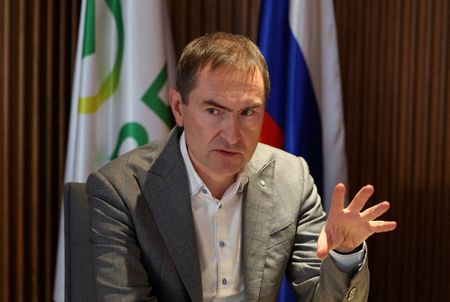
No rouble stablecoins have been issued in Russia yet under the new legislation. But Sberbank's First Deputy CEO Alexander Vedyakhin said he expects that to change soon.
"The market needs a cheap, secure, and fast tool for cross-border transactions, issued under Russian law," he said.
"The legislation establishes the possibility of issuing rouble stablecoins in the form of digital financial assets on public blockchains," he added.
With their value pegged to other assets like a fiat currency or gold, stablecoins are gaining popularity globally even as they face scrutiny over their financial stability and use in money laundering.
In the absence of Russia's own stablecoins, Russian companies have instead primarily used the rouble-pegged A7A5 stablecoin, which was issued by payments firm A7 in Kyrgyzstan last year.
A7A5 turnover reached $140 billion this year, according to Russian bank PSB, which co-founded A7.
Vedyakhin did not say how new Russian-issued stablecoins were expected to perform against A7A5, but he said he expected strong uptake of homegrown payment solutions.
Vedyakhin said that Sberbank was actively working with the central bank under the new law. It received the status of a digital depository and cryptocurrency exchange under the legislation in October and is planning to launch a depository to manage digital securities next month.
Given last month's $6.3 billion hack of Binance, the world's biggest cryptocurrency exchange, Vedyakhin said Russian cryptocurrency infrastructure requires security mechanisms in line with banking sector standards, including protection from human error and social engineering.
"We are doing everything possible for this. Even the largest participants in the cryptocurrency market remain vulnerable to complex cyberattacks based on social engineering," he said.
(Reporting by Elena Fabrichnaya and Gleb Bryanski; Editing by Joe Bavier)
Find it fast
Looking for more insights? Explore our other news sections for updates on sustainable finance, companies and financial education