Nordic business leaders plot to keep companies in home markets
By Marie Mannes
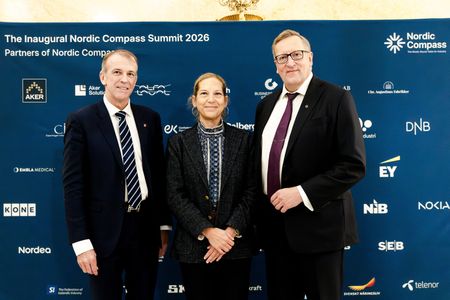
GOTHENBURG, Sweden, Nov 5 (Reuters) - A new Nordic business alliance backed by Sweden's Wallenberg and Finland's Herlin families plans to enlist seven or more "anchor partners" for an independently managed fund to invest in the region's fast-growing companies.
More than 200 business leaders, investors and policymakers are expected to attend the first gathering of Nordic Compass this week in Gothenburg, where it will unveil initiatives spanning capital markets, defence, deep technology and energy.
Nordic Compass expects to enlist seven or more so-called anchor partners to help shape the mandate, size and governance structure of the fund, it said in a statement published on Thursday as part of initiatives unveiled that include plans for a common public marketplace for Nordic financial instruments.
The push reflects concern that fragmented Nordic and European capital markets are sending promising companies to the United States for funding and stock market listings, depriving the region of businesses it needs to compete.
Nordic Compass estimates Nordic companies will need up to €35 billion in series A-C growth capital between 2027 and 2031, leaving a shortfall of about €10 billion even after capital from existing and international investors is taken into account.
The proposal is intended to pool capital that is currently spread across five Nordic countries and complements the EU-backed €5-billion Scaleup Europe Fund, which is designed to help fast-growing companies expand while remaining in Europe.
Lars Rebien Sorensen, a former CEO of Novo Nordisk who now chairs the board of the Novo Nordisk Foundation, told Reuters the foundation’s holding company, Novo Holdings, would potentially be open to investing if the envisioned scale-up funds come into existence.
THIRD-LARGEST MARKET
A second initiative aims to make it easier to buy and sell shares across Nordic borders, creating a more integrated market of about 1,400 listed companies worth roughly €2.5 trillion.
The alliance said the envisioned marketplace would rank as Europe's third-largest market, but exchanges would not merge and instead continue to be run as independent exchanges.
"There are still some barriers for the listed companies and also for the investors that want access to our markets," said Nikolaj Kosakewitsch, the head of Nasdaq Europe, which owns seven of the region's eight exchanges.
"If we can remove some of those ... we believe that will channel a lot more investments into the region," he said, adding that one aim is to synchronise trading, clearing, settlement and custody services so that cross-border transactions are cheaper and more convenient even for retail investors.
Kosakewitsch told Reuters that some of the regulatory framework could take several years and be a complicated process, and cautioned that the Nordic market would become more integrated gradually.
NORDICS TRENDING
While Stockholm is widely seen as one of Europe's leading breeding grounds for unicorns, high-profile Swedish-founded companies, including Spotify and Klarna, have listed in the US.
Jyrki Katainen, Nordic Compass board chair and Nordea's head of public & regulatory affairs, said regional capital pools must be unlocked as globalisation gives way to strategic competition.
"We have plenty of capital in five different Nordic countries, but unfortunately it's very, very national. So if we managed to create a pan-Nordic capital market, it would help the innovative and growing companies stay longer in Nordic countries," he told Reuters.
Katainen said geopolitical shifts had also created momentum.
"I've never seen this sort of enthusiasm from the individual companies and the governments to do things together," he added.
Euronext, which owns the Oslo exchange, joined Nordic Compass this week, saying it was open to measures that reduce fragmentation and encourage cross-border investment.
(Reporting by Marie Mannes; Editing by John O'Donnell and Alexander Smith)
Find it fast
Looking for more insights? Explore our other news sections for updates on sustainable finance, companies and financial education