Explainer-Why a longer working week may not fix Volkswagen's woes
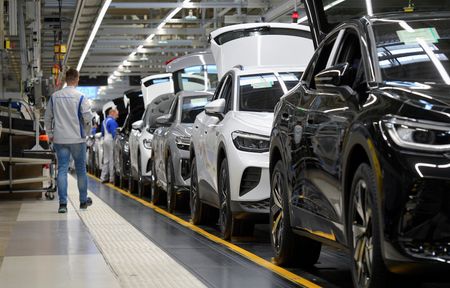
BERLIN, Sept 3 (Reuters) - With a confrontation brewing between management and unions over Volkswagen's restructuring plans amid wider efforts to protect the future of German auto production, attention is turning to the industry's 35-hour working week.
Automakers complain high domestic costs weigh on profit at a time when cheaper models from abroad are stealing market share, part of a broader discussion about German competitiveness.
Here are some facts about the 35-hour week and why extending it may not solve Volkswagen's problems.
WHAT IS THE 35-HOUR WEEK?
The 35-hour week is the full-time standard for many production workers in Germany's metalworking industry, including large parts of the auto sector.
It emerged from collective bargaining agreements negotiated by the IG Metall union in the 1980s and 1990s after a series of strikes, including one lasting seven weeks by the West German metal industry in 1984 under the banner "More time to live, love, laugh".
WHO IS CALLING FOR A CHANGE?
In Saxony, where Volkswagen's Zwickau plant is threatened with closure, state premier Michael Kretschmer said a 40-hour week should be seriously considered, and praised Mercedes-Benz, where management is pushing unions to agree to longer working hours for the same pay.
Kretschmer and Chancellor Friedrich Merz, a fellow conservative, have both warned that the 35-hour week harms German competitiveness, although any change to labour contracts must be negotiated between unions and employers.
HOW EXPENSIVE ARE GERMAN AUTO WORKERS?
According to Oliver Wyman's Harbour Report, Germany has some of the highest automotive labour costs in the world, at about $3,307 per vehicle versus $955 in Spain and $597 in China. The authors say this is down to strong unions and labour regulations.
COULD A 40-HOUR WEEK BE PART OF THE SOLUTION?
Using an example hourly labour cost of €65, auto industry analyst Ferdinand Dudenhoeffer calculates that increasing the standard working week to 40 hours for the same pay could reduce labour costs by some 13%, helping German auto plants maintain or even increase current production.
However, ING chief economist Carsten Brzeski said five more contractual working hours a week would not close the structural gap with low-cost industrial locations like China.
Volkswagen also has a demand problem, and this is not solved by working more, according to unions and some industry observers.
With Volkswagen currently in the process of removing around half a million vehicles' worth of excess annual capacity from its European network and considering the closure of four German plants, if anything workers would need to work less, they argue.
WHAT OTHER OPTIONS ARE THERE?
IG Metall, which represents most Volkswagen workers in Germany, has pushed back strongly against proposals to increase working hours ahead of autumn collective bargaining talks.
One example of co-operation, however, is a 1994 agreement in which Volkswagen management and unions reached a deal where workers accepted lower pay for a 28.8 hour, four-day week.
This bought Volkswagen time to restructure and introduce leaner production methods, helping it ride out a sales slump that the company said threatened 30,000 jobs.
(Reporting by Rachel More and Christina Amann; Editing by Kirsten Donovan)
Find it fast
Looking for more insights? Explore our other news sections for updates on sustainable finance, companies and financial education