Wayve courts automakers with AI driving system that learns like humans
By Norihiko Shirouzu
July 1 (Reuters) - Autonomous-driving startup Wayve is riding a tide of investor interest.
The London-based company has pulled in $2.8 billion from a roster of investors and strategic partners that includes big names across the technology and automotive sectors, from Nvidia to Mercedes-Benz and Nissan. In June, Wayve said it will deploy its system in robotaxis from Jeep maker Stellantis, to go on Uber's ride-hailing network.
Wayve uses an artificial-intelligence technology called end-to-end machine learning to navigate roadways, which is supposed to instantly translate sensor-generated data into driving decisions, much like a human driver. That differs from a more traditional approach, which melds AI with software coding and high-definition maps to create preset rules for how the car should respond in different scenarios, including unforeseen events.
Wayve’s approach is similar to another big autonomous-driving player — Tesla, which moved to an end-to-end model a few years ago. Unlike Tesla’s approach, though, which uses cameras as its only onboard sensor set, Wayve’s system is designed to work with a wide array of sensors and AI chips.
That means it could license the technology to practically any driverless-car developer, said Wayve CEO Alex Kendall, a 33-year-old New Zealander who co-founded the company in 2017, the year he completed his doctorate in AI deep learning at Cambridge University in England.
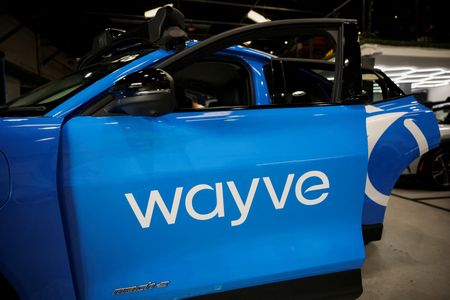
“We want to make full self-driving possible for any vehicle, any brand, and anywhere around the world,” Kendall told Reuters earlier this year, while sitting in the driver’s seat as a Ford Mustang Mach-E outfitted with Wayve’s driverless tech autonomously navigated San Francisco Bay Area neighborhoods where the company has a key tech center.
WAYMO EXPANSION FUELS INDUSTRY MOMENTUM
Competition in the autonomous-driving industry is intensifying after years of missed deadlines and inflated promises. The rapid expansion of Alphabet’s Waymo over the past two years — it now offers paid rides to the public in about a dozen cities, after more than a decade of development — has in part rekindled investor interest in driverless-car developers.
A decade ago, end-to-end AI was an obscure experiment being pursued by a small number of upstream researchers, like Kendall himself. Now, many autonomous-driving developers are deploying at least some aspects of end-to-end learning into their systems.
But the AI-centric approach raises a conundrum: the ambiguous, “black box”-like way that end-to-end systems navigate makes it difficult to interpret the vehicle’s driving decisions. On earlier iterations of driverless cars, which relied on software coding to help vehicles navigate roadways safely, it was easier to determine why the car chose a certain path.
Wayve’s end-to-end AI driving engine produces a safety map of unfolding traffic situations and identifies safe paths for the vehicle. Wayve engineers believe the conventional, programming-intensive safety approach hinders an AI driving system’s ability to stay safe in unusual cases because it is hard to write rules to prepare for very unusual situations.
When such hard-to-predict scenarios happen, the safety logic of a pre-programmed system “becomes brittle,” Wayve’s vice president of AI, Vijay Badrinarayanan, told Reuters. “Human drivers remain safe because they adapt conservatively when they do not know what comes next.”
SHOOTING FOR SAFETY AT SCALE
Waymo uses end-to-end AI now, but also relies on a more conventional, rules-based approach achieved through software coding and maps, which the company says is still needed to ensure safety.
“End-to-end models aren’t enough to guarantee safety at scale,” the company told Reuters.
One of Wayve’s customers, Nissan, is still trying to get comfortable with the system’s safety approach.
Nissan’s tech chief, Eiichi Akashi, said his team is closely assessing Wayve’s tech ahead of the automaker’s plan to deploy it in Japan on a people-mover van called Elgrand during the year ending March 2028. He calls the startup’s system the “most advanced,” but says it is “difficult to peer into it and see how it makes decisions.”
Kendall believes that Wayve, with major operations in Tokyo, Stuttgart and Vancouver, should be able to expand into new markets quickly because it does not need to take the tedious step of mapping roads and writing code to navigate local road quirks. Wayve says it has successfully tested its AI driving system in hundreds of cities around the world without that initial prep work.
Siddartha Khastgir, a professor of safe autonomy at the University of Warwick in England, said end-to-end models should be faster to develop and deploy commercially than more traditional approaches. However, he said, “I wouldn't say that one technology is safer than the other.”
Phil Koopman, a Carnegie Mellon University computer-engineering professor and autonomous-technology expert, said Wayve’s method for handling unusual traffic situations is but one approach, and others may also prove successful. But he still sees it taking at least a decade to deploy driverless systems safely across the U.S.
“It will most likely demand new innovations to get us there.”
(Reporting by Nori Shirouzu in Sunnyvale, California, and Daniel Leussink in Tokyo; Editing by Mike Colias and Matthew Lewis)
Find it fast
Looking for more insights? Explore our other news sections for updates on sustainable finance, companies and financial education