ECB's Lagarde welcomes Iran deal but inflation fears linger

By Hugo Lhomedet and Francesco Canepa
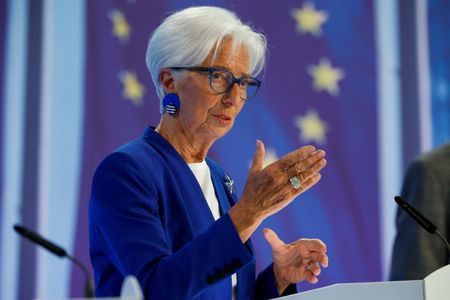
PARIS/FRANKFURT, June 15 (Reuters) - ECB President Christine Lagarde on Monday welcomed news of a U.S.-Iran ceasefire, saying it could help reopen the Strait of Hormuz but some of her colleagues cautioned it would not immediately bring down high euro zone inflation.
U.S. and Iranian officials said overnight they had reached an agreement to end their war and reopen the Strait, a gateway for energy shipment, in a preliminary pact that sent oil prices falling and curbed bets on ECB rate hikes.
"If this news is confirmed by developments in the coming days and the signing of a memorandum of understanding ... it is good news. We can only welcome it," Lagarde told France Culture radio. She cautioned, however, that "the whole question of uranium enrichment remains to be debated, agreed and concluded in the form of an agreement".
The ECB raised interest rates for the first time in nearly three years last week to try to curb inflation before the surge in energy costs that has followed unprecedented supply disruption linked to the Iran war spreads further across the euro zone economy.
Financial investors, who had largely been betting on two more ECB rate hikes over the next year, pared back their expectations on Monday. They now see just one additional increase, with only a marginal chance of a further move.
NAGEL CAUTIOUS ABOUT INFLATION IMPACT
Speaking later in Frankfurt, ECB Governing Council member Joachim Nagel noted financial markets' reaction to the announced agreement showed investors were anticipating a lasting solution to the Iran conflict.
But he remained more cautious about the impact on euro zone inflation, saying there would be no immediate relief even if the Strait of Hormuz reopened soon because it would take months to restore oil supply to its pre-war level.
"No relief is in sight for the foreseeable future," Nagel, who heads Germany's Bundesbank, said. "On the contrary: even if the Strait of Hormuz were to become navigable again soon, it will take months for the oil supply to return to normal."
He said inflation in the euro zone would increase once government measures that knocked 0.40 percentage points off May's inflation reading expire, and that it would remain elevated even in the ECB's "mild" scenario, in which energy prices fall faster. Nagel reaffirmed his view that all options - meaning both holding interest rates steady and increasing them - remain open for the central bank's next policy meeting on July 22 and 23.
KAZIMIR SEES MORE TIGHTENING AHEAD
He was echoed by Slovakian central bank governor Peter Kazimir, who said damage to oil supply could not be undone overnight and put more policy tightening on the table.
"We have taken a first step towards containing medium-term price pressures," he said in an opinion piece. "But the mission is not complete. With today's information, it is increasingly evident that monetary policy has more work to do."
Latvian governor Martins Kazaks also said in a blog post that "a restocking of reserves is likely to take longer" and every meeting was "live" for a potential rate hike.
(Writing by Francesco Canepa in Frankfurt; Editing by Sudip Kar-Gupta Alison Williams and Tomasz Janowski)
Find it fast
Looking for more insights? Explore our other news sections for updates on sustainable finance, companies and financial education