Hard to give rate guidance due to oil price uncertainty, BoE's Dhingra says
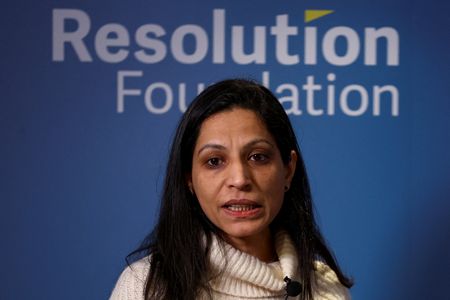
LONDON, June 5 (Reuters) - The difficulty of predicting energy prices during conflict in the Middle East makes it hard to give a steer on interest rates, Bank of England policymaker Swati Dhingra said on Friday.
"If you ask me, what's my interest rate decision next month going to look like, or in the future, I think that's very hard to say because the big elephant in the room here is what happens to the energy crisis," she said at an event hosted by University College London.
Dhingra added she did not have a high degree of confidence in market pricing for future energy prices - which are used in some BoE economic scenarios - and noted they had fallen faster than expected after the 2022 energy shock.
Dhingra was part of the 8-1 majority on the BoE's Monetary Policy Committee who voted to keep rates on hold in April, but went against the consensus in February, before the Iran war broke out, to vote to cut rates by a quarter-point to 3.5%.
In minutes of April's meeting, Dhingra said cutting rates would be appropriate again if the conflict in the Middle East was resolved quickly and oil prices fell sharply, but some tightening might be appropriate if the situation worsened.
Financial markets currently see only a slim chance of a rate rise on June 18 after the BoE's next meeting but see a roughly 80% chance of a quarter-point hike by September.
Dhingra was speaking at an event to launch a new forecasting model by UCL economists that provides regular predictions of future inflation and gross domestic product growth based on statistical relationships rather than ad hoc judgements.
The model currently shows inflation picking up to 3.0% in May from 2.8% in April, while GDP growth slows to 0.3% in the second quarter of the year from 0.6% in the first quarter.
While two of the BoE's main scenarios for inflation show it rising towards 4% by the end of the year, the UCL model showed inflation holding close to 3% for the remainder of 2026.
Understanding the mechanisms driving growth and inflation was more useful for setting interest rates than specific predictions, Dhingra said.
(Reporting by David Milliken and Suban Abdulla; Editing by Andrew Cawthorne)
Find it fast
Looking for more insights? Explore our other news sections for updates on sustainable finance, companies and financial education