Down by the River Thames, a failure to build holds back Britain's growth

By William Schomberg, Kate Holton and Suban Abdulla
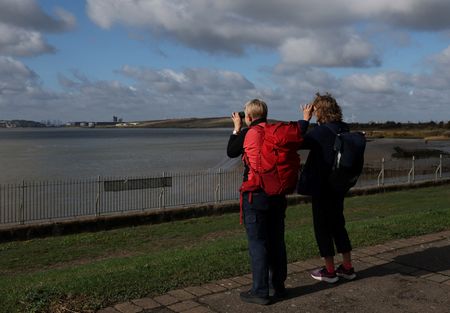
PURFLEET-ON-THAMES, England, Oct 26 (Reuters) - Near the marshes east of London, a £1 billion regeneration plan remains in limbo 17 years after it was first announced, an example of how rising UK building costs are adding to finance minister John Healey's growth challenge in this week's budget.
Local officials still have high hopes for the rebuilding of Purfleet-on-Thames, a popular riverside destination for day-trippers in the Victorian age and a hub of industry in the 20th century before most of the factories closed.
But of about 3,000 planned new homes only 34 have been built after the original developers failed to persuade investors that the financial numbers made sense.
For now, the area earmarked as a future town centre is still mostly a dusty industrial park with an overnight parking lot for truckers.
Despite some progress in streamlining Britain's complex planning system, hopes for a quick pickup in housebuilding and infrastructure - which could accelerate the broader economy - are being thwarted in part by the rising costs of construction.
Interviews with more than 15 planning and policy experts, investors, business leaders and economists show how the accumulation of new policy demands is pushing up those costs.
Combined with sluggish demand as interest rates climb, investors are wary, risking a further slowdown in housebuilding and leaving the government further from its targets.
The new rules range from building safety - following the Grenfell Tower fire in 2017 which killed 72 people - to requirements to improve biodiversity and water quality and reduce carbon emissions.
Gavin Barwell, a former housing minister, said governments had routinely failed to see how multiple policy demands, including worthy ones, can lead to "very significant" cumulative costs, on top of higher taxes, labour costs and inflation.
"The problem could get worse, not better, if you don't address this," he told Reuters, of the need to build.
Many property investors have reduced or halted their projects. Activity in the housebuilding sector has been shrinking for almost all of the last two years, according to a survey by S&P Global, a data firm.
The Home Builders Federation (HBF) estimates 370,000 homes need planning permission every year to meet the government’s target of delivering 1.5 million homes between 2024 and 2029, but approvals are currently running at just 58% of that level.
Taylor Wimpey, a major homebuilder, has said rising costs - including from regulation - and affordability concerns mean it will not start new projects in London.
The HBF said £76,000 had been added to the cost of building a home since 2020. Prosper UK, a pro-growth advocacy group headed by Barwell, says half of that is due to government decisions on regulation, policy and tax.
SUPPORTERS ARGUE PURFLEET HAS HUGE POTENTIAL
In Purfleet-on-Thames, officials are conducting due diligence before reviving the regeneration project with a new developer.
The town is well located for commuters to London, only 30 minutes away by train, and for workers at international shipping ports nearby.
But Thurrock Council documents show the project's previous developer struggled to raise debt and equity to meet high upfront costs for land adaptation and building infrastructure.
A review by KPMG found the viability of a new, initial stage remains "highly constrained". It would require a lower-than-normal provision of affordable housing and £118 million of public funding, KPMG said, at a time when Healey's budget is under strain.
Community representatives expect the regeneration to go ahead but say they have stopped updating local residents.
"People have had their fill of broken promises," Trevor Batchelor, vice chair of the Purfleet-on-Thames Community Forum, said.
UK ALSO STRUGGLES TO BUILD MAJOR INFRASTRUCTURE
The problem is not limited to housebuilding. Around 10 miles further down the river from Purfleet, digging has finally begun on the £10 billion Lower Thames Crossing road tunnel first considered when Margaret Thatcher was prime minister in the 1980s.
It is designed to unblock a choke point on Britain's haulage spine but has been held up by political wavering and a regulatory process slow even by UK standards. The planning application runs to more than 359,000 pages.
Iain McNab, head of policy at the local Chambers of Commerce, said the uncertainty had hindered the area's businesses and given potential investors reasons to think twice.
According to the Boston Consulting Group, the UK was the slowest among several countries it studied for infrastructure pre-construction work, of which planning is a big part.
Chris Stratford, a consultant who worked on the Lower Thames Crossing, said failure by developers to work with local officials and environmental groups can cause delays. He said securing planning consent on a major infrastructure project could cost between £500 million and £1 billion.
That is time and money that Britain can ill afford.
The economy is on course to grow by 1.3% this year, according to the International Monetary Fund, among the fastest in the Group of Seven nations but less than half its average pace in the 15 years before the 2007-09 global financial crisis.
The IMF expects UK growth to slow to 1.2% in 2027, leaving Healey caught between demands for more public spending in areas such as health, education and defence and a bond market that has pushed up the costs of borrowing worldwide.
He is expected to announce few changes to tax and spending in his budget on Wednesday but has signalled plans to cut regulation and the cost of doing business.
MORE HOUSEBUILDING COULD BOOST WIDER ECONOMY
Industry experts say recent reforms should speed up the planning process as they make it harder for opponents to turn to the courts, remove some consultation requirements and give ministers more powers over decisions.
Britain's budget forecasters say the changes could boost productivity and housing services, adding 0.2% to the economy's potential output by 2029, rising to 0.4% in the mid-2030s.
But that growth will struggle to materialise if the industry cannot get building costs down.
For Paul Johnson, chief economist at the 2030 Prosperity Alliance, which seeks to boost growth, housebuilding is the "one single change" that could make a meaningful difference to living standards.
The lack of new housing pushes up prices which discourages people from moving for better jobs, encourages banks and investors to focus lending on property rather than businesses and infrastructure and eats into incomes.
It also exacerbates homelessness which adds to financial pressures on local authorities.
In Purfleet-on-Thames, Batchelor, the community representative, said he remained hopeful the regeneration would attract business to the area.
"We've got plenty of people," he said. "We're just waiting for a town now."
(Writing by William Schomberg and Kate Holton; Editing by Toby Chopra)
Find it fast
Looking for more insights? Explore our other news sections for updates on sustainable finance, companies and financial education