Swiss shears maker pitches fund to shield exporters from strong franc
By John Revill
ZURICH, Aug 4 (Reuters) - A Swiss maker of garden and agricultural shears is rallying support for a new way to protect exporters from the franc's long-term rise, highlighting the pressures faced by smaller manufacturers.
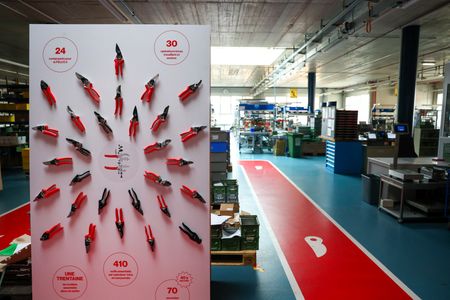
Felco, which sells 95% of its shears abroad to customers including Britain's King Charles and former U.S. First Lady Michelle Obama, has devised an insurance-style scheme, dubbed the Swiss Export Shield, to protect exporters when the franc rises sharply against currencies such as the dollar or euro.
Under the plan, companies would pay into a fund that compensates them if the franc rises beyond an agreed range against major currencies. By pooling risks, and potentially benefiting from government backing, the scheme would be cheaper than bank hedging products such as forwards and options, CEO Nabil Francis told Reuters.
"The scheme would be like an airbag in a car – cushioning the impact, but in this case of the Swiss franc," said Francis, who is pitching the plan to politicians and industry groups.
The franc's safe-haven appeal, underpinned by Switzerland's political and economic stability, low inflation and strong public finances, has long challenged exporters by making their goods more expensive overseas.
That matters because goods exports are equivalent to 60% of Switzerland's gross domestic product, according to government data.
The franc has appreciated by nearly 3% a year against the euro over the past 20 years and by 2.2% against the dollar, though its rise has slowed this year.
"The Swiss franc has become too strong for the Swiss economy," Francis said. "The currency brings a continuous erosion of our margins. We earn our money in dollars and euros, but our costs are in francs."
Nearly all of the country's manufacturers are affected by the strong currency, with nearly half strongly or very strongly hit, according to a survey by industry association Swissmem.
While companies can raise prices to offset some of the impact, doing so risks undermining their competitiveness. Lower profitability can also curb investment.
Innovation and efficiency gains are reaching their limits, Francis said.
SMALL COMPANIES MORE EXPOSED
While larger companies can produce abroad and match foreign-currency revenues with foreign-currency costs, smaller companies, which make up 99% of all Swiss firms, often have fewer options.
The Swiss National Bank has pledged to buy foreign currency to counter sharp rises in the franc. However, a previous effort to cap the currency's value was abandoned in 2015 after becoming too costly to maintain.
Francis said the fund would be managed independently, and would not involve direct government subsidies. However, it would likely require government backing to secure cheaper borrowing using Switzerland's AAA credit rating.
The government and Swiss National Bank declined to comment.
A CARPET 'PERMANENTLY ON FIRE' UNDERFOOT
Jean-Philippe Kohl, deputy director of industry association Swissmem, said the proposal appeared interesting but required closer examination.
"The strong franc has been a constant problem for companies, it's like a carpet that is permanently on fire underneath your feet. Companies have to keep moving and come up with answers,” said Kohl.
Hans Gersbach, director of the KOF Economic Institute at ETH Zurich, had reservations, particularly about a state guarantee needed to borrow more cheaply.
"The central question is, who bears the risk?" he said. "If the franc appreciated sharply against the dollar or euro, many companies could claim at the same time, and payouts could exceed the scheme's reserves."
The proposal has drawn mixed reactions from lawmakers.
Samuel Bendahan, co-leader of the Social Democrats in parliament, said he would raise the idea at the lower house economics committee he chairs and that it could be particularly welcome if it fostered solidarity between large and small companies.
"The opportunity cost of the government doing nothing would be much more expensive," he told Reuters.
Benjamin Muehlemann, co-leader of the centre-right Liberals, or FDP, said a federal guarantee should only be considered if the model can sustain itself without creating false incentives, and "doesn't turn the federal government into the exchange rate insurer for the entire export industry."
(Reporting by John Revill. Editing by Mark Potter)
Find it fast
Looking for more insights? Explore our other news sections for updates on sustainable finance, companies and financial education