Traders trim UK rate hike bets after BoE flags limited Iran spillover
By Harry Robertson
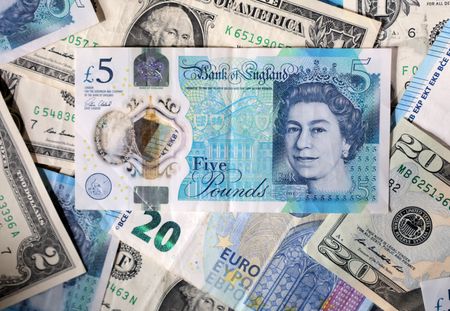
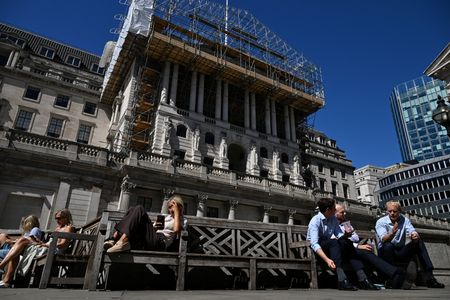
July 30 (Reuters) - Britain's borrowing costs fell and sterling dipped on Thursday as traders nudged down their bets on UK rate hikes, after the Bank of England left rates unchanged and said there were few signs of the Iran war oil shock spreading through the economy.
The BoE's Monetary Policy Committee (MPC) kept rates at 3.75%, although one more policymaker voted for a hike, leading to a 6-3 split as opposed to the 7-2 divide economists polled by Reuters had expected.
Governor Andrew Bailey said there was huge uncertainty around the U.S.-Iran conflict and its impact on energy prices and inflation.
But markets appeared to take comfort from policymakers' comments that domestic factors, for now at least, appeared to be putting downward pressure on inflation.
While traders still fully price in a rate hike by the end of the year, they pared back those bets. They now price in 29 bps of tightening this year, down from 38 bps before Thursday's decision, according to LSEG data.
Britain's two-year government bond yield, which is sensitive to BoE rate expectations, extended its earlier fall to trade 12 basis points (bps) lower at 4.338%. It was set for its biggest one-day fall in over two months.
A drop in short-dated U.S. yields overnight, after the Federal Reserve held rates on Wednesday, also helped pull UK yields lower. Yields move inversely to prices.
Meanwhile, the UK's 10-year bond yield fell 4 bps to 4.992%.
Sterling erased earlier gains against the dollar and euro. It was last trading little changed at around $1.337 and 85.85 pence per euro.
"For now, the Bank is not seeing enough to abandon its wait-and-see approach," said Schroders senior economist George Brown.
"Despite the sharp rise in energy prices, the majority appear unconvinced this will translate into more persistent domestic inflation."
In updated forecasts, the BoE's central projection showed inflation rising to 3.2% later this year from a 15-month low of 2.6% in June.
That is a softer inflation outlook than in the Bank's last full forecasts in April, but similar to what it predicted in June.
IRAN WAR CLOUDS OUTLOOK
Central bankers’ jobs have been complicated by the stop-start U.S.-Iran war which has flared up again in recent weeks, pushing oil prices higher.
Brent crude oil prices have risen more than 20% this month, although at around $90 a barrel they remain well below late April’s peak of $126 a barrel.
The BoE's Bailey and other policymakers stressed that there are few signs the rise in oil prices this year are broadening to push up inflation in non-energy sectors.
The MPC in its statement said there were "clear signs" that inflationary pressures were abating in the domestic economy, citing a weakening labour market.
"The overall decision leans dovish," said ING developed markets economist James Smith.
"Officials are visibly more confident that we won’t see the sort of second-round effects they feared at the start of the Middle East conflict."
Britain's FTSE 100 extended gains slightly and was last up 0.4% at a fresh record high on Thursday.
(Reporting by Harry Robertson in London; editing by Dhara Ranasinghe and Susan Fenton)
Find it fast
Looking for more insights? Explore our other news sections for updates on sustainable finance, companies and financial education