Stocks end quarter with big gains as oil tumbles the most in years; gold, yen also fall
By Rodrigo Campos and Amanda Cooper
NEW YORK/LONDON, June 30 (Reuters) - Stocks across the globe on Tuesday posted their largest quarterly percentage increase in six years, while Brent oil had its largest quarterly drop since 2020 as traders kept tabs on a fragile ceasefire between the United States and Iran.
On the last day of the second quarter, the U.S. dollar posted its fourth straight quarterly rise against a basket of peers, while pushing the yen to a 40-year low, as expectations for U.S. interest rate hikes shifted dramatically. Emerging market currencies as a bloc gained over 1% to the greenback throughout the quarter.
In energy markets, the Strait of Hormuz has reopened gradually and haphazardly as hostilities between the U.S. and Iran receded into a fragile ceasefire, knocking almost 40% off the price of Brent oil over the past three months.
A seemingly unstoppable boom in artificial intelligence stocks kept the equities rally going for the quarter, with South Korea's KOSPI up 68% and Taiwan's benchmark up 45%. The Nasdaq Composite added more than 21%. The MSCI All-World index gained 14.5% in the quarter and touched a record high earlier this month, marking its best quarterly performance since 2020. Emerging market stocks were up 23% for the period.
Europe's STOXX 600, which does not have nearly as many AI beneficiaries as many Asian or U.S. indexes, ended up 10% for the quarter.
"In spite of all the geopolitical stuff, the U.S. economy is performing well and corporate earnings are strong," said Oliver Pursche, senior vice president and advisor for Wealthspire Advisors in Westport, Connecticut. ""We've had a great first half of the year, certainly better than most expected."
For the day, the Dow Jones Industrial Average rose 136.46 points, or 0.26%, to 52,319.20, a record closing high. The S&P 500 rose 58.93 points, or 0.79%, to 7,499.36 and the Nasdaq Composite rose 393.58 points, or 1.52%, to 26,213.72.
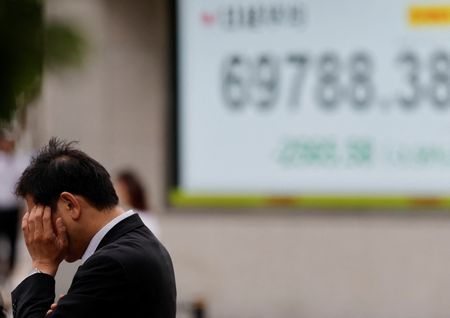
MSCI's gauge of stocks across the globe rose 8.32 points, or 0.75%, to 1,120.37. The pan-European STOXX 600 index rose 0.88%, while Europe's broad FTSEurofirst 300 index rose 23.73 points, or 0.93%. Emerging market stocks rose 16.86 points, or 0.99%, to 1,723.79, while Japan's Nikkei ended up 594.21 points, or 0.86%, to 70,062.32.
DOLLAR UP
The dollar has been the standout winner this quarter among developed currencies, gaining 1.3% against a basket of peers. Yet emerging market currencies have also strengthened 1.3% this quarter against the greenback.
The dollar has found support as markets increasingly price in the likelihood of Federal Reserve rate hikes. U.S. inflation remains well above target, the economy continues to grow and the Fed's latest quarterly projections show nine of 19 policymakers anticipate a rate hike by year-end.
“The dollar has strengthened further since the (Fed) meeting, supported by widening growth differentials that we've started to see between the U.S. and other major economies which were amplified by higher oil prices,” said James Lord, head of FX EM strategy at Morgan Stanley.
“Recent economic data points to stronger U.S. performance, particularly against the eurozone, where growth indicators have been comparatively softer.”
The world's most influential central bankers are in the Portuguese town of Sintra this week for the European Central Bank's annual meeting, and no one will be more in the spotlight than new Federal Reserve Chair Kevin Warsh, who is scheduled to address the gathering on Wednesday.
The dollar's rise has partly driven gold to a 14% quarterly drop, its largest such fall since 2013, while the yen fell to its weakest point in 40 years to trade around 162.57 per dollar late on Tuesday. Traders were on edge about a possible Japanese intervention, with Finance Minister Satsuki Katayama issuing another warning.
Katayama's comments "avoided the verbal escalation that often precedes a buying effort, instead reiterating that authorities stand ready to respond at any time," said Karl Schamotta, chief market strategist at Corpay.
Brent crude futures for Augustsettled 0.3% lower on the day at $72.92 per barrel. The contract posted its third-straight monthly decline, down over 20% in June and off 38% for the quarter. U.S. crude fell 31% this quarter, yet both Brent and WTI are close to 20% higher year to date.
"I wouldn’t say the market has priced out a risk premium, but previously stranded ships have become available with the increase in ships moving out of the Gulf, creating a temporary wave of new supply," UBS analyst Giovanni Staunovo said.
Morgan Stanley said it now models an implied global oil market surplus of 4.8 million barrels per day in 2027.
(Reporting by Rodrigo Campos in New York and Amanda Cooper in London; Additional reporting by Karen Brettell, Alun John, Anushree Mukherjee, Caroline Valetkevitch, Niket Nishant, Dhara Ranasinghe and Tom Westbrook; Editing by Alexander Smith, Matthew Lewis, Nick Zieminski and Cynthia Osterman)
Find it fast
Looking for more insights? Explore our other news sections for updates on sustainable finance, companies and financial education