Analysis-Guilty verdict against Andrew Left to shake up activist short-selling playbook
By Saqib Iqbal Ahmed and Michelle Price
NEW YORK, June 3 (Reuters) - A U.S. jury's fraud conviction of prominent investor Andrew Left this week could rewrite the playbook for activist short sellers, raising fresh questions about the line between legitimate market activism and stock manipulation.
Activist short sellers bet a company's stock price will fall while publicly launching campaigns that typically include publishing research reports, posting on social media or appearing on cable news.
Unlike traditional short sellers who trade quietly, activists court public exposure to highlight what they see as poor performance or bad management decisions by companies in the hopes they'll move the shares.
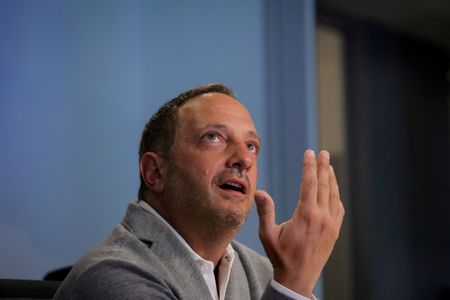
Left was found guilty of engaging in a securities fraud scheme. Prosecutors made the case that he exploited his influence through social media and cable news appearances to tout what he said were his trades, only to quickly and secretly close out his positions to profit from short-lived price movements.
While the case is specific to Left's dealings and he may appeal, market participants said the verdict could prompt other activist short sellers to rethink how they have been doing business.
"I don't think this changes short selling in general, but I do think it fundamentally changes activist short selling," said Scott Nations, president of Nations Indexes and the author of The Anxious Investor: Mastering the Mental Game of Investing.
"Plain-vanilla short selling is still about valuation, positioning, and risk; that part of the market will go on as before. But activist short selling depends on going public," he said.
"Once a jury verdict like this lands, it raises the legal and reputational stakes for anyone whose strategy relies on broadcasting displeasure as part of the thesis," Nations said.
Short activists have long argued that they are shielded by their First Amendment rights to free speech, while the law also allows investors to change their minds. Some lawyers said the Justice Department successfully portrayed Left as an opportunist whose goal was to profit by scaring retail investors, something Left repeatedly denied during the trial, saying he believed in his calls.
"It’s tough to know how much of the verdict is due to the general dislike of short sellers versus these Left-specific factors, though, and the costs to short sellers of making the wrong guess are huge, and that’s where the chilling comes in," Peter Molk, a law professor at the University of Florida who has studied the long-term effects of short activism, said in an email to Reuters.
Spokespeople for Left and the DOJ did not immediately respond to a request for comment. Shortly after the verdict, Left posted on X: "So now a truthful opinion that ends up making money is illegal. Is this America?"
YEARS-LONG PROBE
Investors and academics broadly agree that short selling -- the practice of selling borrowed shares to benefit from a share price decline -- is generally beneficial to the market by helping weed out fraud, operational failures and overvaluation at the target firms.
But activist short sellers have long drawn the ire of companies that have fought to curb their bets, accusing them of waging predatory campaigns, spreading false or misleading rumors to artificially depress stock prices for a quick profit.
Left's trial was the culmination of a years-long investigation by criminal prosecutors in Washington and Los Angeles, who began probing short sellers in 2019, Reuters and others have reported.
That probe, Reuters previously reported, was partly sparked by 2018 research by Columbia University professor Joshua Mitts whose analysis of 1,720 pseudonymous posts attacking publicly listed stocks on financial website Seeking Alpha between 2010 and 2017 found they were preceded by unusual and suspicious trading through stock options, in a process he called "short and distort". Short sellers have disputed his methodology and findings. Mitts declined to comment.
In addition to Left, the Justice Department probed Muddy Waters’ Carson Block, Anson Funds and Marcus Aurelius Value, Reuters and others reported at the time. The Justice Department to date has only charged Left, and Reuters has reported that authorities dropped their probe into Block. Block did not immediately respond to a request for comment.
Canada’s Anson Advisors, meanwhile, settled with the Securities and Exchange Commission on charges it failed to disclose its relationship with Left.
Other high-profile short sellers have in recent years left the market. Jim Chanos closed his short-focused hedge funds in 2023, according to a source familiar with the matter, and Nathan Anderson's Hindenburg closed in 2025, citing the toll of the "rather intense, and at times, all-encompassing" nature of the work.
Other funds still active in the space are Spruce Point Capital and Culper Research.
Spruce Point Capital, Culper Research, Hindenburg, Block, Chanos and Anson did not immediately respond to a request for comment on the verdict and its implications for activist short sellers.
"Short-selling is useful on both sides – the traders and the public – as long as it is properly done," said Gontran de Quillacq, CEO of Navesink International, which provides expert witness and litigation support services for the financial markets.
"The comments point to the individual’s wrongdoing, not in general. This is only a matter of enforcement, not a systemic problem," he said, referring to the Left verdict.
(Reporting by Saqib Iqbal Ahmed and Michelle Price; Additional reporting by Anirban Sen; Editing by Megan Davies and David Gregorio)
Find it fast
Looking for more insights? Explore our other news sections for updates on sustainable finance, companies and financial education