Explainer-Why EU leaders are struggling to Le Pen-proof the bloc’s €1.6 trillion budget
By Jan Strupczewski
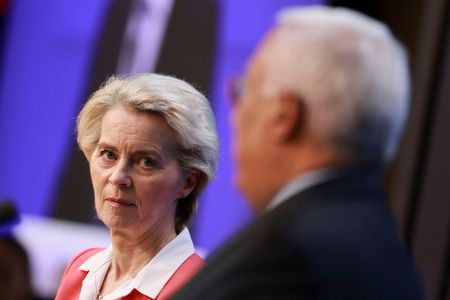
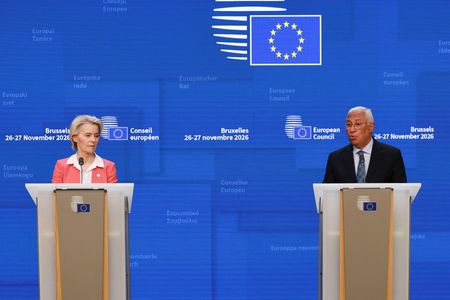
BRUSSELS, Nov 27 (Reuters) - European Union leaders' talks on the bloc's 2028-2034 budget collapsed on Thursday, with divisions among member states proving deeper than anyone had anticipated. While no breakthrough had been expected, the rifts between the 27 countries were so stark that the gathering was cut short, with the leaders abandoning a second day of talks originally planned for Friday, unwilling to make compromises.
Most of them had hoped to lock in a legally binding deal before the end of the year — and well before France's presidential election in April-May 2027 that could bring far-right leader Marine Le Pen to power. Attention now turns to crunch talks scheduled for December 17-18, where negotiators will have to make up lost ground.
HOW BIG IS THE EU’S BUDGET AND WHERE DOES THE MONEY COME FROM?
The latest proposal, already scaled down from the original in 2025, puts the seven-year budget at €1.582 trillion.
Two-thirds of the budget comes from national contributions based on each country's gross national income, which is why governments fight tooth and nail to keep their net payments as small as possible.
The budget also gets money from:
• 75% of all customs duties on imports from outside the EU collected by EU countries
• 0.3% of each country's value-added tax receipts, calculated from a harmonized base so contributions are comparable despite differing VAT rates
• a levy of €0.80 per kilogram (€800 per ton) of non-recycled plastic packaging waste from each country
• competition law fines, contributions of non-EU countries to certain EU programmes and taxes on EU staff salaries
To boost revenue and reduce national contributions, EU governments are considering assigning the revenue from the following sources to the EU budget: a digital services tax on large companies, the Carbon Border Adjustment Mechanism, non-recycled electronic waste, tobacco products, and the carbon Emissions Trading System.
WHAT HAS LE PEN SAID ABOUT FRENCH CONTRIBUTIONS IF SHE WINS THE PRESIDENCY?
The prospect of a Le Pen presidency is focusing minds in EU countries, since she has vowed to cap French contributions to the EU budget at €5 billion a year. France is the bloc's second-biggest net contributor after Germany, paying between €21 billion and €31 billion a year gross and around €9 billion net. It is unclear whether Le Pen's €5 billion cap refers to gross or net contributions.
Le Pen has also said France would halt financial support for Ukraine against Russia's invasion if she wins, shifting a larger burden onto other EU countries wanting to keep helping Kyiv.
HOW COULD SHE DERAIL THE PROCESS?
Because the EU budget must be agreed unanimously, a single veto can derail the process. If no legally binding deal is reached before Le Pen takes office, she could use that veto, sending all 27 countries back to the drawing board.
Also, the funding agreement, called the "Own Resources Decision," must be ratified by most national parliaments, including France's. If EU governments reach a budget deal before France's April-May elections but it isn't yet ratified there, the deal would not be legally binding and could unravel.
WHAT ARE EU MEMBER STATES HAGGLING OVER?
Size of budget: Net contributors and net beneficiaries are sharply split over the budget's overall size — contributors want it much smaller, while beneficiaries want it to grow.
Rebates: Net contributors also want rebates to further cut what they send to EU coffers, making it harder to fund priorities such as security and defence, competitiveness, climate action, agriculture and support for poorer regions.
How to spend it: Another sticking point is what to spend the money on. Most cash still goes to supporting farmers and fishermen and raising living standards in poorer regions — policies that have dominated the budget for decades. Some countries want to shift funds toward research, innovation and new technologies to bolster the EU's competitiveness against rivals like China and the United States.
HOW IS THE BUDGET APPROVED?
The budget must be unanimously agreed by all 27 EU governments, then negotiated with the European Parliament. Afterward, the "Own Resources Decision" covering all funding sources must be ratified by national parliaments.
HOW IS MONEY FOR UKRAINE LINKED TO THE EU BUDGET?
The EU agreed last year to lend Ukraine €90 billion for 2026-2027. All EU governments except Hungary, Slovakia and the Czech Republic agreed to jointly borrow the money against the EU budget — a move that still required unanimous approval, including from the three reluctant countries.
A new €45 billion loan for 2027 is to be arranged the same way, but this time Germany and others insist all 27 countries must participate — Germany says it won't agree to the 2028-2034 budget otherwise.
The EU has also earmarked €100 billion for Ukraine in its 2028-2034 budget. That is unlikely to be enough: interest alone on Ukraine's existing EU loans, also paid by the EU, will total €55 billion to €65 billion over that period, officials say. Financing Ukraine's loans and interest is a challenge for governments already struggling with heavy public debt and voter displeasure over living costs.
(Reporting by Jan Strupczewski; Editing by Hugh Lawson)
Find it fast
Looking for more insights? Explore our other news sections for updates on sustainable finance, companies and financial education