Stocks fall; bond market flips to 'higher for longer' mode
By Amanda Cooper
LONDON, Sept 28 (Reuters) - Global stocks fell on Monday, as oil jumped on the stalemate in US-Iranian talks and action in the Treasury market pointed to investors preparing for interest rates to rise and remain higher for a protracted period of time.
Over the weekend, US President Donald Trump rejected an Iranian proposal to reopen the Strait of Hormuz and said talks would continue this week, though Iran shows no sign of watering down its proposals.
Brent futures rose 4% to $108.5 a barrel, bringing gains so far this month to 20%. Oil futures are 50% above where they were before the war started in late February, while refined product prices have surged even more.
Markets now imply a 68% chance the Fed will hike for a second straight meeting in October, with around 90 basis points of tightening priced out to late next year.
Two-year Treasury yields, which are the most responsive to shifts in expectations for rates and inflation, have shot up 56 basis points in September, in their largest monthly rise since February 2023, in anticipation of a wave of Fed hikes.
This rise has narrowed the discount of 2-year yields to benchmark 10-year yields to around 30 bps from around 40 bps a month ago, a dynamic known as a flattening of the yield curve.
This is often seen as a precursor to recession, as investors price for longer-term growth to slow, but in this case it is more a reflection of the greater compensation they demand in anticipation of rising rates.
"The bond market is not flashing crisis. It is pricing US resilience and a higher equilibrium rate — while exposing economies less able to absorb higher borrowing costs," Mark McCormick, chief FX strategist at BMO, said.
With US growth and corporate earnings booming, Wall Street and Main Street have broadly been able to digest the rise in yields and a higher oil price, for now.
But the increasing cost of capital is emerging as a key risk to AI-linked companies, particularly the so-called hyperscalers, whose billions of dollars in borrowing and spending have powered stock markets everywhere.
Two-year yields were last up 5 bps on the day at 4.914%. Yields on 30-year bonds edged up to 5.52%, having hit their highest since 2004 last week, while 10-year yields were up 4 bps at 5.22%.
That said, market-based measures of inflation expectations have been relatively stable and for US markets at least, remain well off the highs back in May, said Steven Major, global macro advisor at Tradition.
"Consequently, the upward movement in nominal Treasury yields is predominantly explained by higher real yields and shifting policy expectations, rather than a runaway inflation risk premium," he said.
MSCI's All-World index was down 0.2% on the day and set for a 2% gain this quarter.
S&P 500 futures fell 0.5%, while Nasdaq futures dropped 1%.
TECH STOCKS DENTED
European equity markets were a bright spot. The STOXX 600 was up 0.1%, driven by oil and gas stocks.
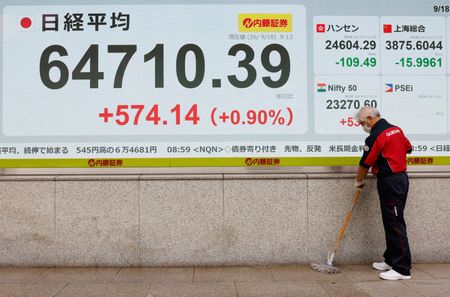
Overnight in Asia, Chinese blue chips slid 1.9% to a one-year low after a group of US lawmakers introduced legislation on Friday to bar the federal government from equipping sensitive government systems with Chinese-made components used to transmit data in AI data centres.
The US data calendar is packed with readings on inflation, GDP, manufacturing and jobs.
The recent spate of upbeat figures has boosted the dollar index to two-month peaks at 101.39. The euro was down at $1.1383, having lost 2.0% so far this month.
The yen strengthened on Monday, after Japan's top currency diplomat Atsushi Mimura, in an interview with Reuters, issued another warning to any would-be sellers. The dollar was last down 0.1% at 157 yen.
Meanwhile, gold slid 3% to $4,151 an ounce, having fallen nearly 7% this month as yields have risen.
(Additional reporting by Wayne Cole in Sydney; Editing by Lincoln Feast, Andrew Cawthorne and Jan Harvey)
Find it fast
Looking for more insights? Explore our other news sections for updates on sustainable finance, companies and financial education