Toyota revamp hints of wider industry shake-up in China
BEIJING/SHANGHAI, Sept 15 (Reuters) - A potential tie-up between Toyota's two main Chinese partners could be a sign the long-standing foreign joint-venture model in China is entering a new phase as a shrinking market and brutal competition force automakers to become more efficient.
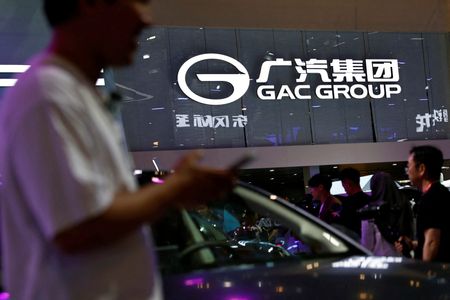
Guangzhou Automobile Group (GAC) said on Monday it planned to acquire part of FAW Group's stake in an unnamed auto JV with an overseas-listed company. Chinese state media reported the venture was FAW Toyota, potentially paving the way for closer integration of Toyota's two China businesses.
GAC and FAW did not respond to requests for comment. Toyota declined comment.
China, the world's largest auto market, is on the cusp of a shakeout after years of rapid expansion left it with vast overcapacity and more than 100 competing car brands.
The proposed deal may foreshadow broader industry consolidation as overcapacity has undermined the economics of parallel networks, analysts said.
The auto industry has "long been suffering from involution, or loss-leading competition," S&P Global Ratings said in a note on Tuesday, warning that weak demand, overcapacity and the rapid EV shift are testing state-owned automakers and their foreign JVs. "We anticipate a broader wave of industry restructuring over the next two to three years," S&P said.
For decades, Toyota expanded in China through separate partnerships with FAW in the north and GAC in the south, a strategy that helped it build scale in a fast-growing market. But as growth has slowed, competition intensified and the shift to electric vehicles squeezed profits, the rationale for maintaining parallel operations has weakened.
Bill Russo, founder of Shanghai-based consultancy Automobility, said there was a "sound industrial logic" to the move because Toyota could make its sales and distribution more efficient and lower overlapping investment.
But he cautioned that greater efficiency alone would not solve the challenges facing foreign automakers in China.
"The more fundamental issue is the loss of relevance many global automakers face in consumer-facing technology," Russo said, adding that consolidation on its own would not restore the relevance of Toyota's products.
"You can become more efficient at building a car that consumers increasingly overlook," he said.
JOINT VENTURES UNDER PRESSURE
Foreign automakers that once dominated China's auto market have steadily lost ground to local rivals over the past five years. BYD, Geely and Chery have gained greater market share with rapidly developed electric and hybrid vehicles and are now expanding aggressively overseas.
Jia Ke, founder of consultancy Auto Business Review, said the traditional joint-venture model under which foreign automakers have operated in China for decades has come under pressure.
"As the industry's profit pool continues to shrink, redundant investment and internal inefficiencies are becoming increasingly untenable," he wrote in a note.
Toyota has already seen its share of China's passenger market fall over recent years and there have been signs of consolidation in its China operations.
Its two China JVs accounted for 7% of passenger vehicle sales in the first eight months of the year, ranking behind BYD, Geely Auto and Volkswagen, according to China Passenger Car Association data.
In 2021, the two ventures together ranked second, only behind Volkswagen, highlighting how sharply and rapidly local brands have risen.
Toyota has sought to streamline its operations in response. Reuters reported in late 2024 that the automaker was looking to bring its sales and production operations closer together as part of its ambition to turn the tide in China.
Signs of a shift are already visible. FAW Toyota's dealer network has shrunk more than 15% to 651 this year from a peak of 773 stores in 2022, according to data from China Automobile Dealers Association analyst Li Yanwei. GAC Toyota's network fell more than 10% over the same period to 620 from 693 dealerships.
The challenge that Toyota and other foreign auto brands face in China is that the country's auto industry remains trapped in a brutal price war triggered by years of investment and capacity growth, putting pressure on profit margins.
The government has repeatedly warned of overcapacity and the detrimental impact of price wars. Profit margins in the vehicle manufacturing segment have fallen to 1.5%, the lowest in nearly a decade, official data showed.
Last week, China's top economic planner reiterated support for mergers and restructuring among major automakers.
Volkswagen, China's largest foreign automaker for much of the past three decades, also operates through partnerships with FAW and SAIC that were established when rapid growth rewarded expansion and market coverage.
Among Japanese automakers, Honda and Nissan have cut output in China as sales weakened, while Mitsubishi Motors stopped producing cars in the country altogether.
Zhou Xiaoying, founder of automotive supply-chain platform Gasgoo, said the JV structures had once enabled foreign automakers to rapidly expand in China, but the industry is now entering a new phase with evolving priorities.
"Priorities are changing," she said. "Faster decisions, lower costs and a more unified market strategy."
(Reporting by Zhang Yan in Shanghai, Ju-min Park, Qiaoyi Li in Beijing; Writing and additional reporting by Daniel Leussink in Tokyo; Editing by Jacqueline Wong)
Find it fast
Looking for more insights? Explore our other news sections for updates on sustainable finance, companies and financial education