G20 finance chiefs except China back action on distorted trade
By Philip Blenkinsop and David Lawder
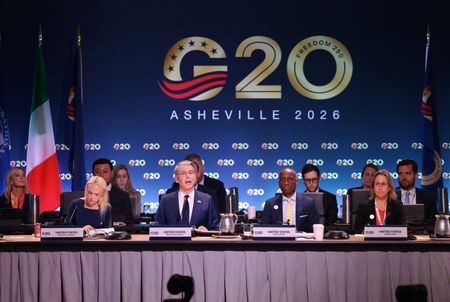
ASHEVILLE, North Carolina, Sept 1 (Reuters) - The Trump administration won backing from all G20 financial leaders except China's on Tuesday to act against "non-market" policies and distortions that cause over-reliance on exports and hinder growth elsewhere.
The finance ministers' meeting clearly focused on China, while Washington used a parallel G20 gathering of industry titans and commerce ministers to make the case for a hands-off approach to AI regulation.
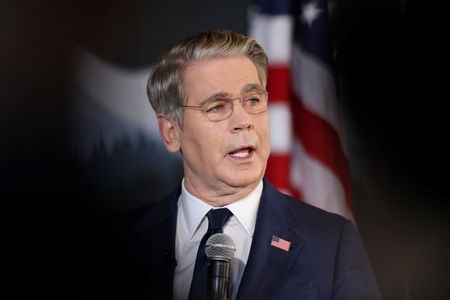
U.S. Treasury Secretary Scott Bessent said he had been proven right when he warned other trading partners last year that tougher U.S. tariffs would lead to an influx of Chinese goods diverted to their markets.
"We believe that non-market-based economies pushing out a never-ending stream of cheap exports is not sustainable," he told a news conference. "I think that the fact that 19 countries did want to address this shows the sheer the enormity of the problem."
A G20 chair's statement to conclude the meeting said the participants, except China's, agreed that countries should eliminate "non-market policies" that exacerbate imbalances.
"In particular, countries with excessive and persistent external surpluses should remove distortions that constrain domestic consumption and that result in an over-reliance on exports for growth," the statement said.
The two-day meeting of finance chiefs - which saw differences in tone between the U.S. hosts and some European participants - came amid a global bond market selloff on worries over growing debt levels and inflation pressures.
European countries and Canada expressed dismay that Russia, invited by the forum's U.S. hosts, attended for the first time since it invaded Ukraine in 2022.
CHINA'S MASSIVE EXPORT PUSH
China's massive export push has pressured economies across the globe, especially as the United States has imposed high tariffs on Chinese goods and outright bans on some products, such as Chinese vehicles.
With chronically weak domestic demand, China has doubled down on exports of electric vehicles, semiconductors and other goods, and its total exports rose 23.9% in July year-on-year, prompting growing calls in Europe for tougher curbs on Chinese imports.
G20 member China has shown little interest in longstanding calls for it to reduce industrial subsidies and rebalance its economy, while its yuan currency remains significantly undervalued by most measures.
China's goods trade surplus with the European Union hit €360.6 billion last year, a 15% increase on 2024, and has expanded further this year.
European Economy Commissioner Valdis Dombrovskis said in a briefing that China is a major source of economic imbalances, but said the U.S. and Europe both also had roles to play in evening things out.
In more direct comments, German Finance Minister Lars Klingbeil said the US- and Israeli-led Iran war, together with ongoing U.S. tariff disputes, were also major causes of uncertainty holding back the global economy.
"Uncertainty is poison for economic growth," he said. "The tariff conflicts being pursued by the U.S., such as the current dispute with Canada, destroy trust."
Britain said it would maintain a pragmatic trade relationship with China, while navigating what it said was the sensitive issue of trying to reduce imbalances. Canada, which has forged closer economic ties to China since the start of the year, was engaging with China no differently than other G7 countries and with "clear guardrails," its finance minister Francois-Philippe Champagne said.
International Monetary Fund Managing Director Kristalina Georgieva told Reuters she believed China recognized it needed to take action, but they were calling more for coordinated action with others, such as the United States reducing its growing fiscal deficits, which contribute to excessive import demand.
Beijing has also leveraged its dominance in processing of critical minerals by placing export restrictions on rare earths in April 2025, a response to U.S. President Donald Trump's tariffs that has also affected non-U.S. companies.
Japanese Finance Minister Satsuki Katayama, speaking late on Monday, said she had told her G20 counterparts that arbitrary export restrictions on critical minerals were harming the global economy. The issue was included in the G20 chair's statement.
"We urge countries to avoid unnecessary export restrictions to ensure global supply chains continue to function normally," it said.
A selloff in global bond markets deepened on Tuesday, with Japan's 10-year bond yield hitting 3% for the first time since 1996 - the latest manifestation of investor concern about energy-driven inflation, potential monetary tightening and worsening fiscal conditions.
Treasury officials said Bessent had called for sound monetary policy to anchor inflation expectations and avoid excessive currency volatility during his meeting on Sunday with Bank of Japan Governor Kazuo Ueda.
"I have information that the market doesn't have, and it's my belief that the Japanese government and the BOJ will do the things that will lead to a stronger yen," Bessent told CNBC in an interview.
The remarks, which underline Bessent's recent calls for the BOJ to raise interest rates, were seen by the markets as aimed at bolstering the case for a rate hike at the BOJ's policy meeting on September 17-18.
(Reporting by David Lawder, Philip Blenkinsop and Leika Kihara; Editing by Andrea Ricci and Nick Zieminski)
Find it fast
Looking for more insights? Explore our other news sections for updates on sustainable finance, companies and financial education